Into the Darkness
If you ever wanted to explore a world stranger than anything in science fiction, you wouldn’t need a spaceship or a portal to another dimension. You’d need a vessel capable of sinking far below the surface of the ocean, past the shimmering blues where sunlight dances, past the dim twilight where colors fade into gray, and into the pitch‑black realm known as the midnight zone. Down here, sunlight is nothing more than a rumor, pressure is a constant and unforgiving force, and the creatures that drift, stalk, and glow in the darkness look more like visitors from distant galaxies than anything that belongs on Earth. This is the deep ocean, a place where evolution has been allowed to get wonderfully, wildly weird.
What the Midnight Zone Really Is
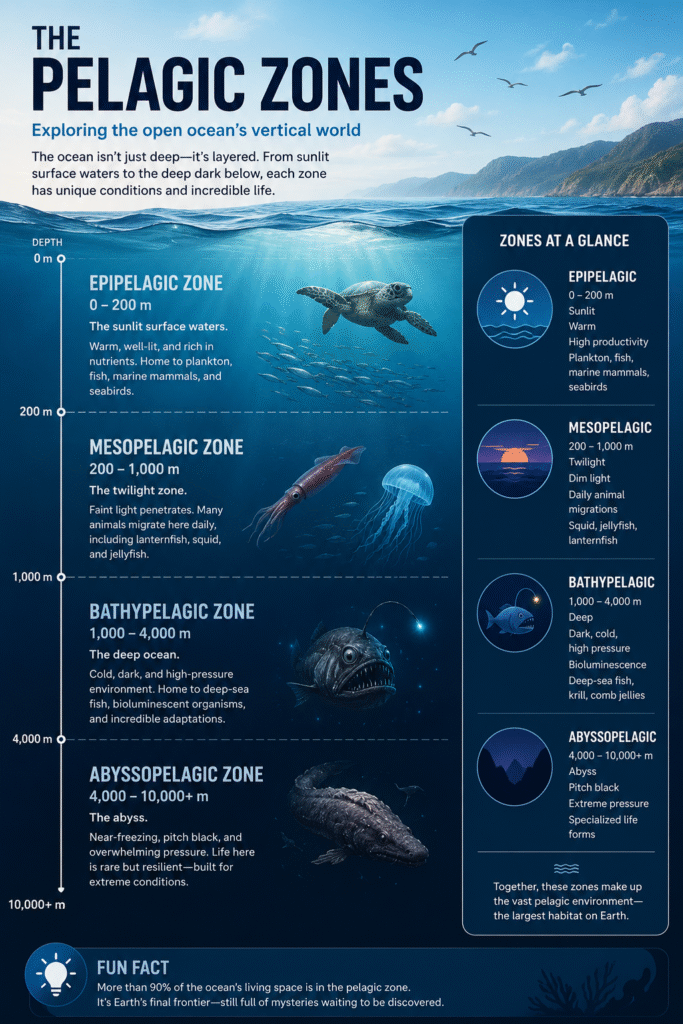
The midnight zone, or bathypelagic zone, begins around a thousand meters below the surface and stretches down several kilometers into the abyss. It is a world of eternal night, where temperatures hover just above freezing and the weight of the water above presses down with the force of small buildings. The darkness is absolute, the silence is profound, and the environment is so extreme that most life on Earth could not survive a single moment here. Yet life does survive. It thrives, in fact, in forms so strange and inventive that they challenge our understanding of biology itself. The deep sea is not barren; it is a cosmic carnival of glowing lures, gelatinous bodies, enormous jaws, and evolutionary strategies that seem to defy logic.
The Anglerfish: A Lantern in the Void
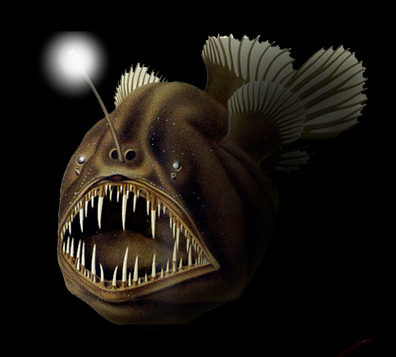
Among the most iconic residents of this abyssal world is the anglerfish, a creature that looks like it was designed by someone who had only a vague idea of what a fish should be and decided to lean fully into nightmare aesthetics. Its body is often squat and lumpy, its skin dark and leathery, and its mouth a cavern of needle‑sharp teeth angled inward like a biological bear trap. But the anglerfish’s most famous feature is the glowing lure that dangles from its forehead, a tiny lantern powered by bioluminescent bacteria. In the pitch‑black void, this lure becomes a beacon of curiosity for smaller creatures, which drift toward the light only to discover, too late, that the light is attached to a mouth. The anglerfish doesn’t chase its prey; it waits, patient and still, letting the darkness do the work for it.
As terrifying as the anglerfish may appear, its adaptations are not monstrous—they are ingenious. In a world where food is scarce and energy must be conserved, the anglerfish has evolved into a master of ambush. Even its love life is shaped by the challenges of the deep. Males are tiny compared to females, often no larger than a walnut, and their sole purpose is to find a mate in the vast, empty dark. When a male encounters a female, he bites her and never lets go. Over time, his body fuses into hers, his organs dissolve, and he becomes a permanent, living attachment that provides sperm whenever she needs it. It is one of the strangest reproductive strategies on Earth, but in the midnight zone, where encounters between individuals are rare, it is a brilliant solution.
The Vampire Squid: A Gentle Goth in the Abyss
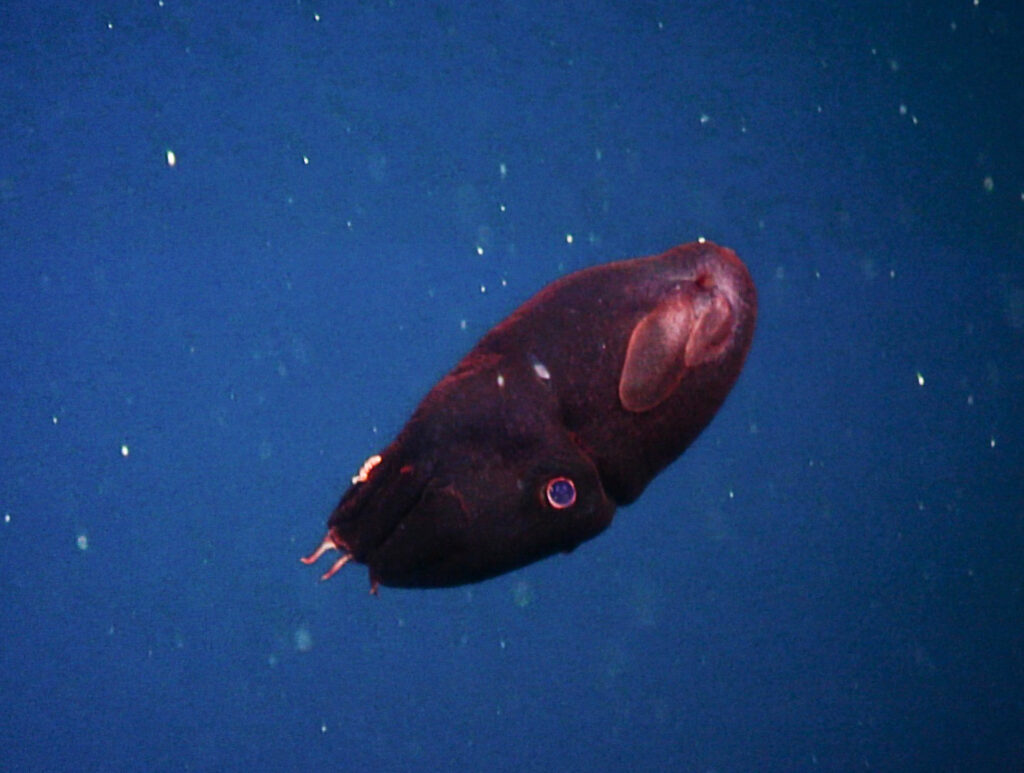
Not all deep‑sea creatures are fearsome. Some are simply strange in a way that feels almost whimsical, like the vampire squid. Despite its dramatic name, the vampire squid is not a predator of blood or a terror of the deep. It is a gentle, drifting creature with a soft, gelatinous body and a cloak‑like webbing between its arms that gives it the appearance of a floating umbrella. Its coloration ranges from deep red to velvety black, and its eyes glow an otherworldly blue in the darkness. The vampire squid does not chase prey; instead, it feeds on “marine snow,” the poetic term for the constant rain of organic particles that drift down from the upper layers of the ocean. It collects these particles using long, sticky filaments, rolls them into little nutrient‑rich balls, and eats them with quiet efficiency.
When threatened, the vampire squid performs one of the most dramatic defensive maneuvers in the animal kingdom. It turns itself inside out, flipping its arms over its body and exposing spiky projections that make it look like a floating, spiny pumpkin. This sudden transformation startles predators and gives the vampire squid a chance to drift away into the darkness. It is a creature that embodies the deep sea’s blend of elegance and oddity, a reminder that not all aliens of the abyss are frightening—some are simply beautifully strange.
The Gulper Eel: A Living Cartoon in the Dark
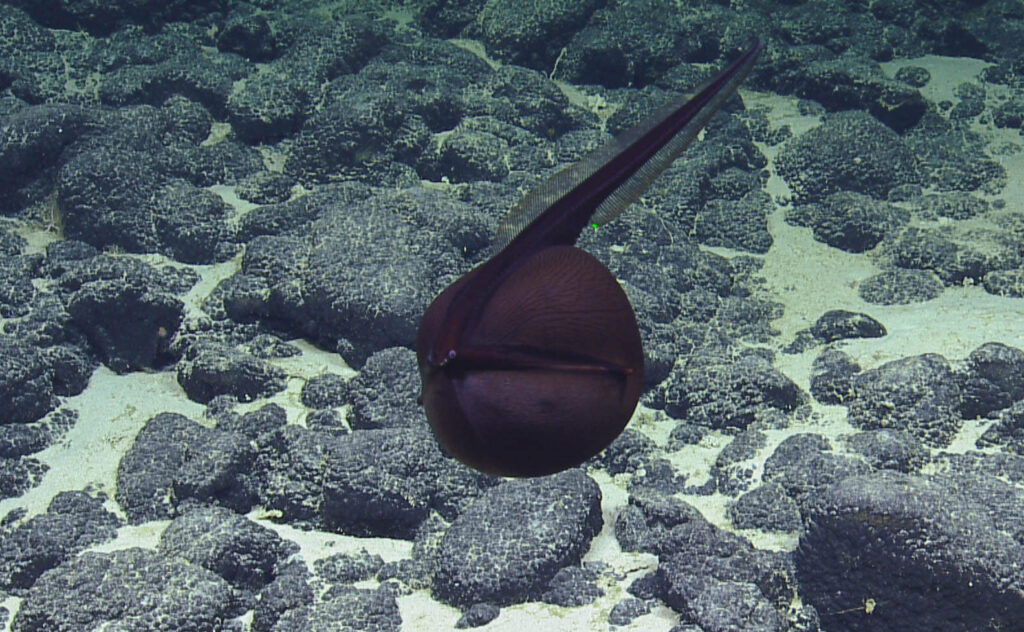
Then there is the gulper eel, a creature so bizarre that it feels like a glitch in evolution. Its most striking feature is its enormous mouth, which can open wide enough to swallow prey nearly as large as itself. The gulper eel’s jaw is hinged in such a way that it can balloon outward like a living parachute, creating a cavernous trap for anything unfortunate enough to drift too close. Its eyes are tiny, almost vestigial, and its body tapers into a long, whip‑like tail that ends in a glowing organ. Scientists believe this glowing tip may act as a lure, drawing curious creatures toward the eel’s waiting mouth. The gulper eel is not a fast swimmer, nor is it a graceful one, but in the deep sea, where meals are rare and opportunities fleeting, its enormous mouth gives it a crucial advantage.
Every sighting of a gulper eel feels like a moment of surreal discovery. They are rarely seen, and when they do appear on camera, they move with a kind of awkward majesty, their balloon‑like jaws inflating and deflating as if they are trying to decide what shape they want to be. They are living proof that evolution in the deep sea is not constrained by the rules we expect.
The Crushing Reality of Blackwater Pressure
All of these creatures—anglerfish, vampire squid, gulper eels, and countless others—are shaped by the same invisible sculptor: pressure. The deeper you go, the more the ocean presses in from all sides. At the surface, we experience a single atmosphere of pressure. At the depths of the midnight zone, pressure can reach hundreds of atmospheres, enough to crush submarines and implode steel. Yet the creatures that live here are perfectly adapted to this crushing environment. Their bodies are soft and flexible, with minimal air spaces that could collapse under pressure. Their tissues contain specialized proteins that keep their cells functioning even under immense force. If you were to bring one of these creatures to the surface, it would not survive; its body is built for the deep, just as ours is built for the air.
Pressure shapes everything in the midnight zone. It determines how creatures move, how they hunt, how they reproduce, and even how they glow. It is the constant, invisible force that has guided evolution into strange and unexpected directions.
Why the Deep Ocean Feels More Alien Than Space
For all our fascination with outer space, the deep ocean remains the more mysterious frontier. We have sent humans to the Moon, landed rovers on Mars, and photographed galaxies billions of light‑years away, yet we have explored only a tiny fraction of our own ocean. Space, for all its vastness, is predictable in its emptiness. The deep sea, by contrast, is full—full of life, full of movement, full of chemical and geological processes that we are only beginning to understand.
The deep ocean is a realm where superheated hydrothermal vents create underwater chimneys, where brine pools form lakes within the sea, and where methane seeps support entire ecosystems independent of sunlight. It is a place where creatures glow like stars, where bodies stretch and shrink in ways that defy logic, and where every expedition seems to uncover something new. In many ways, the deep sea is our best model for what extraterrestrial life might look like. If life can thrive in the crushing dark of Earth’s abyss, it may very well thrive in the oceans of distant worlds.
The Language of Light
One of the most enchanting aspects of the deep sea is bioluminescence. In the absence of sunlight, many creatures create their own light through chemical reactions within their bodies. This light is used for everything from attracting prey to confusing predators to communicating with potential mates. Some species glow softly, like drifting stars. Others flash in rapid bursts, creating underwater fireworks. Some even use bioluminescence as camouflage, glowing on their undersides to match the faint light from above and rendering themselves invisible to predators below. It is a language of light in a world of darkness, a reminder that life will always find a way to adapt.
The Deep Sea’s Role in Our World
The midnight zone is not just a scientific curiosity. It plays a vital role in Earth’s climate, absorbing heat and carbon and helping regulate global temperatures. It supports food webs that extend all the way to the surface. It contains organisms with unique chemical compounds that could inspire new medicines. And it remains one of the last great frontiers of exploration on our planet. Every time we descend into its depths, we are reminded of how little we know and how much there is still to discover.
The Last Great Frontier
The deep ocean is alien, yes, but it is also profoundly beautiful. Its creatures glow, drift, stalk, and shimmer in ways that defy imagination. Its landscapes are shaped by forces more powerful than anything on land. Its mysteries are vast, and its secrets are waiting. We do not need to look to the stars to find the unknown. We only need to look down, into the midnight zone, where the aliens of the deep blue sea continue to thrive in the darkness, reminding us that our own planet is still full of wonders.

If you loved learning about the anglerfish:
This mechanical building set brings that eerie design to life in your hands. Piece by piece, you assemble a biomechanical deep-sea hunter complete with its signature lantern, skeletal frame, and alien beauty. It’s part model, part creature, part nightmare-from-the-abyss, and it looks incredible on a shelf.
I’m a Squishmallows collector myself, so I’m biased, but Easton is one of those perfect “weird but adorable” designs. The anglerfish glow-lure detail mixed with that classic Squishmallow softness makes him equal parts deep-sea creature and bedtime companion. He’s the kind of plush that feels like it belongs in an ocean documentary… and your bed.
If the Gulper Eel Stuck With You
A full set of deep-sea creatures you can hold in your hands. This Safari Ltd TOOB includes the legendary gulper eel alongside other abyssal icons: tiny, detailed, and oddly mesmerizing. It’s part toy, part specimen jar, and perfect for anyone who fell in love with the strange life of the midnight zone.
A gulper eel, but make it festive. This ornament turns one of the strangest creatures of the deep sea into a holiday conversation piece that is equal parts creepy, funny, and weirdly charming. Perfect for ocean lovers who want their Christmas tree to have a little midnight zone chaos hanging from it.
If the Vampire Squid Is More Your Vibe
The vampire squid already looks like it belongs in a myth. This tarot-style design leans all the way into it. Dark, surreal, and instantly eye-catching, it turns a real deep-sea creature into wearable art that feels like it came from the midnight zone itself.
A rare deep-sea favorite made kid-friendly. The vampire squid is one of the ocean’s strangest drifters, and this Octonauts version turns it into an instantly recognizable, collectible learning toy. Perfect for sparking curiosity about real deep-sea life before it disappears back into the dark.
If the Midnight Zone Calls to You
A deep dive into the strangest ecosystem on Earth. This book pulls you into the abyssal zone where pressure shapes life into forms that feel almost impossible. If the midnight zone fascinated you, this is the next layer down, where the ocean gets even more alien and even more real.
A visual descent into total darkness. This book captures the midnight zone in full atmosphere, where glowing creatures drift through endless night and nothing behaves the way you expect. If you wanted to actually feel the deep ocean instead of just read about it, this is it.
A place to hold your thoughts after the deep sea stays with you. Minimal, quiet, and designed for reflection, sketches, and notes from a world that does not have light. Perfect for anyone who left the midnight zone and is not done thinking about it.