I think I was about seventeen when I bought my first Michael Crawford CD. I’d been OBSESSED with The Phantom of the Opera since… well, forever. The first Phantom I ever saw live was Colm Wilkinson at the Pantages Theatre (which has since been renamed, thus dating me), but the cast recordings they sold were of the Original Broadway Production starring Sarah Brightman and Michael Crawford.
Michael Crawford In Concert has sold over two million copies, with mine being one of them. And at seventeen years old, I discovered that Michael Crawford was the most adorably hilarious man to predate Ryan Reynolds.
As he tells it, he was coming out of the loo when Andrew Lloyd Webber stopped him and declared, “We must do Phantom of the Opera together.” Crawford agreed, naturally, because who turns down Andrew Lloyd Webber in a hallway? The next day, he read the novel and realized there were only two men of any real importance: the handsome Vicomte de Chagny, Raoul… and the decidedly less handsome Phantom. Obviously Andrew wanted him to play Raoul, right? So he went out and bought the Claude Rains film version, the one with Nelson Eddy as Raoul.
For the next year, he lived and breathed Nelson Eddy. By the end of it, he looked like Nelson Eddy, walked like Nelson Eddy, talked like Nelson Eddy. So when he arrived at the audition, he struck his most Raoul‑esque pose and announced, “You have found your Raoul.”
And Andrew said, “Yes, yes we have. We hired him last week.”
“…What?”
“We want you to play the Phantom.”
“WHAT?!?”
And so he was.
I adore that story — but not as much as I adore what happened next.
In front of a live audience, Michael Crawford… Broadway legend, international star, beloved original Phantom… said, “With your permission, I’d like to show you my Raoul.”
The audience lost it. Except for one woman, apparently, who sounded confused — it was a CD, so I couldn’t see her, but you can hear the moment Crawford realizes what he’s just said. The sheer mortification in his voice as he scrambles to clarify: “My INTERPRETATION of Raoul… dearest.” And I can just picture him, beet red, shaking his head in profound embarrassment before gently assuring the confused woman, “He’ll explain it to you later, ma’am.”
And I love it, not for the crudeness of the humor, but for the sheer chaos of it. The kind of chaos that happens when someone is onstage, in the moment, unabashedly themselves. Theatre, as any thespian will tell you, is chaos incarnate. But no one manages it quite as endearingly as the original Erik, Michael Crawford.
Michael Crawford: Unmasked
When one talks about Michael Crawford, or really Phantom of the Opera by association, since that was his iconic role, what they normally picture is this:
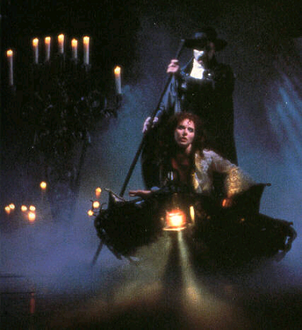
When one talks about Michael Crawford, or really Phantom of the Opera by association since that was his iconic role, what they normally picture is the image of him in the boat with Sarah Brightman. The mask gleams white against the darkness, the cape sweeps behind him, and the entire tableau feels like a gothic painting come to life. It is the version of him that has been immortalized in promotional stills, posters, and the collective memory of theatre lovers. It is the Michael Crawford who haunts the chandelier and the imagination. Yet if we look at his career before he donned the mask and the cape and stole our hearts as the original Erik Destler, the Opera Ghost, the Angel of Music and the Phantom of the Opera, there is a great deal more to uncover.
Michael Crawford did not begin as a brooding romantic figure. He began as a comic actor with a gift for physicality and timing that bordered on acrobatic. Long before he was the tortured genius beneath the Paris Opera House, he was the young man who could fall down a flight of stairs with balletic precision or deliver a line with such earnest confusion that audiences dissolved into laughter. His early work in Black Comedy with Lynn Redgrave showcased this talent beautifully. In that production, he played a character navigating a world where the stage lights represented darkness and the darkness represented light. It was a clever theatrical device that required the actors to move as if blind whenever the stage was fully illuminated. Crawford excelled at this. He threw himself into the physical demands of the role with a kind of fearless abandon that would later become one of his trademarks.
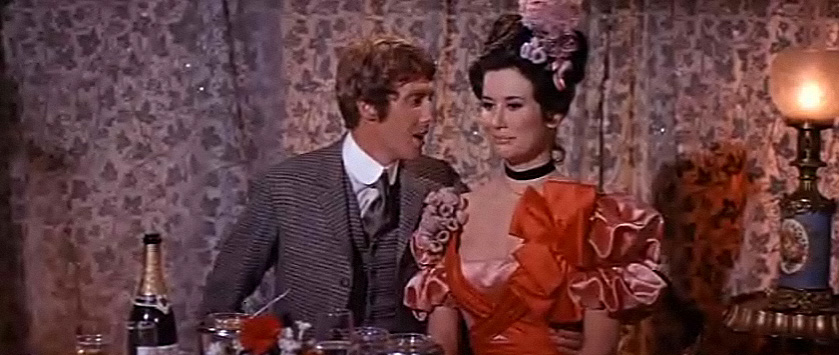
He also charmed audiences as Cornelius Hackl in Hello Dolly. In that role he was all wide eyed enthusiasm and youthful optimism. He sang with a bright, clear tone that carried a sense of innocence. He danced with a kind of joyful awkwardness that made him instantly endearing. It is almost impossible to reconcile that version of Michael Crawford with the man who would later sing Music of the Night with such sensual intensity that entire generations of theatre goers would swoon. Yet both versions are equally true. Both are essential to understanding the performer he became.
Crawford’s early career was a patchwork of unexpected opportunities and surprising turns. He appeared in films, television shows, and stage productions that allowed him to explore a wide range of characters. He was never the sort of actor who could be easily categorized. He could be funny, dramatic, tender, or chaotic depending on what the moment required. That versatility would become one of his greatest strengths when he stepped into the role that would define him.
Becoming the Phantom
When Michael Crawford was cast as the Phantom, he was not the obvious choice. He was not known for playing dark or mysterious characters. He was not known for operatic singing. He was not known for brooding romantic intensity. Yet Andrew Lloyd Webber saw something in him that others had not. Perhaps it was the emotional sincerity he brought to every role. Perhaps it was the way he could make even the most absurd situations feel grounded and human. Perhaps it was the vulnerability that lived just beneath the surface of his performances. Whatever it was, it convinced Webber that Crawford could bring the Phantom to life in a way no one else could.
Crawford approached the role with the same dedication he had shown when preparing to play Raoul. He studied the character with meticulous care. He explored the Phantom’s psychology, his loneliness, his longing, and his rage. He worked with vocal coaches to develop a sound that was both powerful and haunting. He collaborated with choreographers to create a physicality that conveyed the Phantom’s otherworldly presence. He immersed himself in the world of the Paris Opera House until it felt like a second home.

What emerged from this process was a performance that redefined the character. Crawford’s Phantom was not a monster. He was a man who had been shaped by pain and isolation. He was brilliant, passionate, and deeply wounded. He wanted love but did not know how to ask for it. He wanted connection but had been denied it for so long that he no longer believed he deserved it. Crawford played him with a tenderness that made the tragedy of the story feel inevitable. His Phantom was not frightening because he was evil. He was frightening because he was human.
This interpretation resonated with audiences in a way that few performances ever do. People saw themselves in his longing. They saw their own insecurities reflected in his mask. They felt the ache of his desire to be seen and loved. Crawford’s Phantom became the definitive version of the character because he made him real.
The Voice That Changed Everything
One of the most remarkable aspects of Crawford’s performance was his voice. It was not the traditional operatic baritone that many expected. Instead, it was a voice filled with emotion. It carried a kind of trembling intensity that made every note feel personal. When he sang Music of the Night, it felt like a confession. When he sang All I Ask of You (Reprise), it felt like a plea. When he sang the final lines of the show, it felt like a farewell that lingered long after the curtain fell.
Crawford’s voice was not perfect in the classical sense. It cracked at times. It strained. It revealed the effort behind the sound. Yet that imperfection became part of its beauty. It made the Phantom feel more human. It made the music feel more intimate. It made the story feel more immediate. Crawford did not sing like a man performing for an audience. He sang like a man revealing his soul.
This vulnerability became one of the defining features of his Phantom. It set him apart from the performers who came after him. It created a standard that others would try to emulate but never quite replicate. Crawford’s Phantom was not just a character. He was an experience.
The Chaos and the Charm of Michael Crawford
What makes Michael Crawford so endlessly fascinating is the contrast between his onstage intensity and his offstage personality. Onstage he was the Phantom, a figure of mystery and passion. Offstage he was the man who accidentally made an innuendo in front of a live audience and then tried to correct it with the flustered charm of someone who had just realized what he said. He was the man who could command a stage with a single gesture and then turn around and laugh at himself for tripping over a prop. He was the man who could make an audience cry with a single note and then make them laugh with a single line.
This duality is part of what makes him so beloved. He is both the legend and the human being behind the legend. He is both the Phantom and the man who once spent a year studying Nelson Eddy because he thought he was supposed to play Raoul. He is both the icon and the accidental comedian. He is both the mask and the face beneath it.
Legacy of a Legend
Michael Crawford’s impact on Phantom of the Opera cannot be overstated. He shaped the role in ways that continue to influence performers today. He set a standard for emotional depth, vocal expression, and physical presence that has become the benchmark for every Phantom who followed. His performance helped establish the show as a global phenomenon. His interpretation became the foundation upon which the legacy of the musical was built.
Yet his legacy extends beyond Phantom. He has continued to perform in a variety of roles that showcase his versatility. He has continued to bring joy to audiences with his humor, his sincerity, and his unmistakable voice. He has continued to be a figure of admiration and affection for fans around the world.
What makes his legacy so enduring is not just the roles he played but the way he played them. He approached every character with honesty. He gave every performance his full heart. He treated every moment onstage as an opportunity to connect with the audience. That authenticity is what people remember. That authenticity is what makes him unforgettable.
The Phantom Who Wanted to Be Raoul
There is something poetic about the fact that Michael Crawford spent a year preparing to play Raoul only to be cast as the Phantom. It feels like a metaphor for his entire career. He has always been the performer who surprises you. He has always been the performer who reveals something unexpected. He has always been the performer who shows you a side of a character you did not know you needed.
The Phantom who wanted to be Raoul became the Phantom who defined the role. The man who studied Nelson Eddy became the man who inspired countless others. The actor who began in comedies became the actor who delivered one of the most iconic dramatic performances in musical theatre history.
Michael Crawford did not set out to become the Phantom. He simply followed the path that opened before him. Yet in doing so, he created something extraordinary. He created a Phantom who was not just a character but a symbol. A symbol of longing. A symbol of vulnerability. A symbol of the beauty that can be found in imperfection.
And perhaps that is why his story continues to resonate. It reminds us that sometimes the roles we are meant to play are not the ones we expect. Sometimes the paths we take lead us to places we never imagined. Sometimes the mask reveals more than it hides.
Michael Crawford’s Phantom is a testament to the power of embracing the unexpected. It is a reminder that greatness often comes from the moments when we step into the unknown. It is a celebration of the chaos, the humor, the vulnerability, and the brilliance that make theatre what it is.
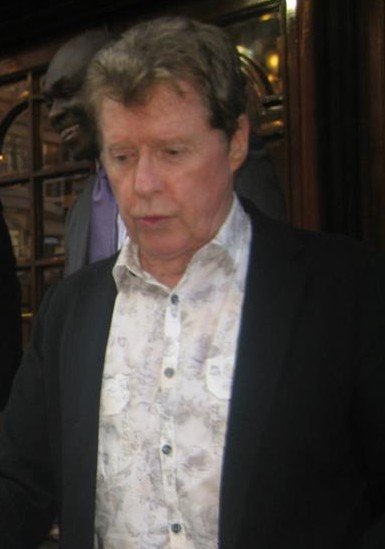
And it all began with a man who thought he was supposed to be Raoul.
Supporting Autumnelf on Ko‑Fi helps fuel new essays, book projects, ocean‑life explorations, theatrical deep dives, and the creative quests that make Phantom Orca Quest a vibrant, multimedia experience.
Get Me a Spark of Magic