The city hums, brakes squeal, and sixteen strangers take a breath that sounds suspiciously like a promise; in Another Day of Sun, optimism comes on in rose-colored jazz shoes — bright, practiced, and ready to stumble upward.
The Mythic Freeway: Where Dreams Merge with Asphalt
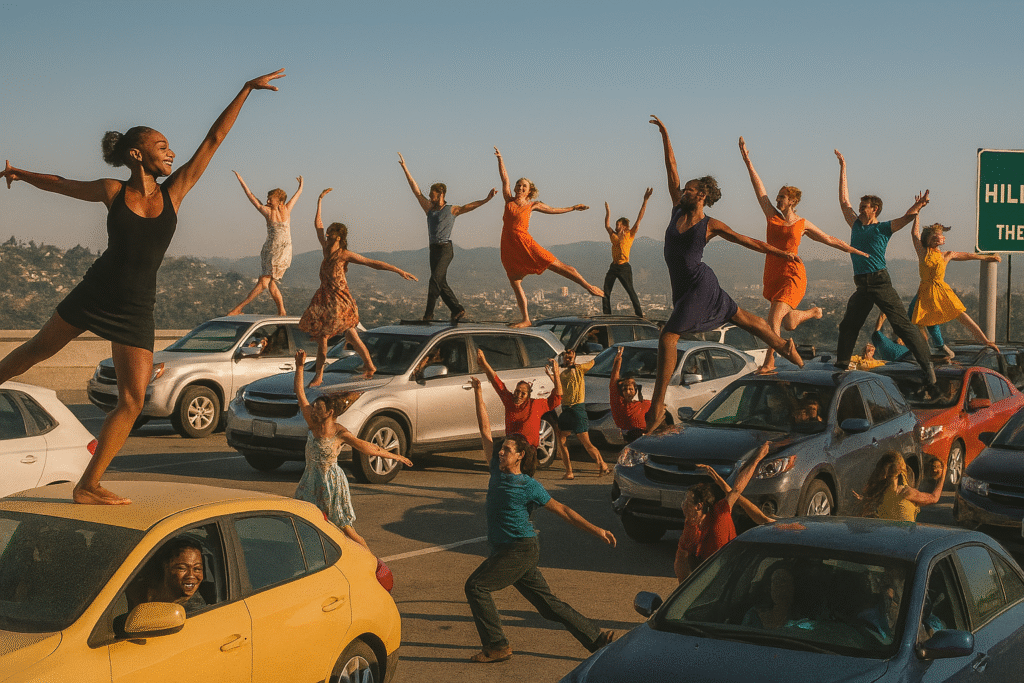
The opening number of La La Land doesn’t just introduce characters — it introduces a worldview. A traffic jam on a Los Angeles freeway becomes a stage, a liminal space where stalled ambition erupts into motion. The setting is mundane, even frustrating, but the choreography transforms it into a mythic threshold. This isn’t just a commute; it’s a collective audition for possibility.
The freeway ramp is elevated, both literally and symbolically. It lifts the dancers above the city, granting them a panoramic view of the dream they’re chasing. The camera glides through the ensemble like a hopeful breeze, catching snippets of movement, color, and longing. The dancers don’t just perform — they declare. Each gesture is a small rebellion against inertia.
Choreography as Communal Pulse
Choreographer Mandy Moore (not the singer-actress, but the Emmy-winning dance visionary) crafts movement that feels both spontaneous and ritualistic. The choreography is built on motifs that ripple through the ensemble: shoulder pops, hip swivels, directional shifts that mimic the chaos of traffic but stylize it into rhythm. These aren’t isolated solos; they’re interwoven phrases that suggest a shared vocabulary of hope.
What’s striking is the choreography’s refusal to center a single protagonist. Instead, it democratizes the spotlight. Each dancer gets a moment — a turn, a leap, a glance — but the power lies in the ensemble’s cohesion. Optimism here isn’t individualistic; it’s viral. One dancer’s joy infects the next, and the freeway becomes a feedback loop of possibility.
Spatially, the choreography plays with levels and depth. Dancers leap from car roofs, slide between lanes, and form diagonal lines that guide the viewer’s eye across the frame. The movement is directional — always forward, upward, outward — even when the dancers are technically stuck in traffic. It’s a visual metaphor for ambition: constrained by circumstance but irrepressibly kinetic.
The Sound of Hope: Tempo, Texture, and Catchiness
Musically, Another Day of Sun is engineered for uplift. Composer Justin Hurwitz crafts a score that blends jazz exuberance with musical theatre clarity. The tempo is brisk but breathable, inviting both exhilaration and singalong. It’s the kind of rhythm that makes your foot tap before your brain catches up — a physiological optimism.
The instrumentation is bright: brass punches, piano flourishes, and percussion that mimics the clatter of city life. There’s a syncopated energy that mirrors the choreography’s bounce. The melody is catchy not because it’s simple, but because it’s structured around repetition and variation. Each verse introduces a new character’s dream, but the chorus returns like a sunrise — familiar, reassuring, and slightly different each time.
Harmonically, the song favors major keys and tonic resolutions. Even when it dips into minor or chromatic territory, it quickly resolves upward. This musical architecture reinforces the theme: setbacks are temporary, and the tonal center always returns to hope.
Lyricism and Layered Longing
The lyrics, penned by Benj Pasek and Justin Paul, walk a delicate line between earnestness and irony. Each verse offers a snapshot of a dreamer — a singer, a screenwriter, a dancer — who came to Los Angeles chasing stardom. Their stories are specific, but their emotions are universal. The dreams are big, but the details are intimate: a missed audition, a fading headshot, a voicemail from a casting director.
What makes the lyrics resonate is their emotional layering. On the surface, they’re cheerful. But beneath the rhymes and rhythms lies a quiet ache. The characters sing about success, but they also hint at sacrifice. The optimism isn’t delusional — it’s wishful, aspirational, and deeply human. It’s the kind of hope that knows failure but chooses movement anyway.
The chorus — “Another day of sun” — is both literal and metaphorical. It’s a weather report and a mantra. It acknowledges the passage of time, the persistence of effort, and the cyclical nature of ambition. The sun rises again, and so do the dancers.
Hollywood as Dreamscape and Mirage
La La Land is a love letter to Hollywood, but it’s also a critique. The opening number sets the tone: the city is beautiful, but it’s indifferent. The freeway is a stage, but it’s also a bottleneck. The dancers are radiant, but they’re also stuck. This duality is central to the film’s ethos.
Hollywood is portrayed as both muse and mirage. It offers possibility, but it demands resilience. The dancers in Another Day of Sun aren’t naive; they’re seasoned. Their optimism is choreographed, rehearsed, and slightly frayed at the edges. They know the odds, but they dance anyway.
The visual palette reinforces this tension. Bright costumes pop against the gray asphalt. Sunlight floods the frame, but shadows linger. The color grading is warm, but not saccharine. It’s a city of contrasts — glamour and grit, fantasy and fatigue.
The Role of the Ensemble: A Chorus of Hope
In traditional musical theatre, the ensemble often serves as background — a decorative frame for the leads. But in Another Day of Sun, the ensemble is the story. There are no stars, only dreamers. The camera doesn’t linger on a single face; it moves, glides, and samples. This choice democratizes the narrative. It says: every dream matters, every dancer counts.
The ensemble’s diversity is also notable. The cast includes performers of various ethnicities, body types, and dance styles. This isn’t just aesthetic — it’s thematic. The song celebrates the plurality of ambition. Hollywood may have gatekeepers, but the freeway is open to all.
The ensemble’s energy is contagious. Their movements are precise, but their expressions are loose. They smile, grimace, laugh — often within the same phrase. This emotional fluidity makes the choreography feel lived-in. It’s not just performance; it’s ritual.
Cinematic Technique: Movement as Narrative
Director Damien Chazelle uses the camera like a dance partner. The opening shot is a long take — a continuous glide through the ensemble that mimics the choreography’s flow. This technique creates immersion. The viewer isn’t watching a number; they’re inside it.
The camera’s movement is rhythmic. It accelerates during high-energy phrases, then slows for emotional beats. It pans, tilts, and cranes in sync with the dancers. This synergy between cinematography and choreography reinforces the theme: optimism is a moving target, and the camera chases it.
Editing is minimal during the number. Cuts are rare, and transitions are smooth. This choice preserves the illusion of spontaneity. It suggests that the dance could happen anywhere, at any time — that joy is always one breath away.
Costume and Color: Dressing the Dream
Costume design in Another Day of Sun is subtle but effective. Dancers wear bright, solid colors — reds, blues, yellows — that pop against the neutral backdrop. These choices aren’t just aesthetic; they’re symbolic. Each color represents a mood, a dream, a personality.
The costumes are practical — breathable fabrics, flat shoes, minimal accessories — but they’re also theatrical. They suggest readiness: these dancers could audition, rehearse, or perform at a moment’s notice. The jazz shoes are especially telling. They’re functional, but they also signal identity. To wear jazz shoes is to declare: I am a dancer, even in traffic.
Color also functions as emotional shorthand. Warm tones suggest passion, cool tones suggest introspection. The ensemble becomes a moving palette, painting the freeway with feeling.
Thematic Resonance: Hope as Practice
Ultimately, Another Day of Sun is about hope — not as emotion, but as practice. The dancers don’t just feel optimistic; they enact it. Their movements are declarations, their lyrics are affirmations. They rehearse joy, even when the outcome is uncertain.
This theme resonates beyond the film. In a world of stalled traffic and delayed dreams, the number offers a blueprint for resilience. It says: move anyway. Sing anyway. Hope anyway.
The optimism isn’t blind. It sees the obstacles, the rejections, the missed connections. But it chooses choreography over stillness, melody over silence. It chooses rose-colored jazz shoes.
Legacy and Cultural Impact
Since its release, Another Day of Sun has become iconic. It’s been parodied, referenced, and reimagined. Dance troupes have recreated the number in parking lots, rooftops, and subway stations. The song has entered the cultural lexicon as shorthand for hopeful beginnings.
Its legacy lies in its accessibility. You don’t need to be a dancer to feel the rhythm, or a singer to hum the tune. The number invites participation. It says: you, too, can step into the traffic and find your spotlight.
For musical theatre lovers, it’s a masterclass in ensemble storytelling. For film buffs, it’s a technical marvel. For dreamers, it’s a reminder that the freeway isn’t just a bottleneck — it’s a stage.
Final Bow: Why It Matters
The brilliance of Another Day of Sun lies in its refusal to offer easy answers. It doesn’t promise success, fame, or even survival in the industry. Instead, it offers choreography as a kind of spiritual practice — a way to keep moving when the world stalls. The dancers don’t escape traffic; they transcend it, if only for a few minutes. That transcendence is fleeting, but it’s enough. It’s a reminder that joy can be conjured, even in gridlock.
This number also reframes what it means to be a protagonist. In a culture obsessed with individual triumph, La La Land opens with a chorus. It says: before we meet Mia and Sebastian, we meet everyone. The freeway jam becomes a metaphor for shared striving, and the ensemble becomes a collective protagonist. Their dreams may be different, but their choreography is unified. That unity is radical. It suggests that hope isn’t just personal — it’s communal.
For artists, performers, and anyone chasing a dream, this number offers a kind of emotional blueprint. It acknowledges the grind, the rejection, the stalled momentum. But it also insists that movement is possible. Not because the obstacles disappear, but because the dancers choose to move anyway. That choice — to rehearse joy, to embody hope — is what makes the number revolutionary.
And for viewers outside the industry, the number still resonates. It’s a portrait of resilience, of people who sing not because they’re winning, but because they’re still trying. That kind of optimism isn’t naive — it’s defiant. It’s rose-colored, yes, but the shoes are scuffed. The dancers have been here before. They know the choreography by heart. And they choose to perform it again.
In the context of La La Land, this opening number sets the tone for a film that will explore love, loss, ambition, and compromise. But it also stands alone — a self-contained celebration of movement, music, and meaning. It’s a reminder that musicals don’t just entertain; they ritualize emotion. They turn longing into choreography, disappointment into harmony, and traffic into theatre.
For your blog, Harls, this piece can be a touchstone — a way to invite readers into the layered world of musical theatre without demanding advocacy or soapbox energy. It’s lighthearted, yes, but it’s also rich. It offers a way to talk about choreography, tempo, and staging while still honoring the emotional truth beneath the glitter. And it gives you room to be playful, poetic, and precise — all at once.
Whether you’re writing for fellow performers, curious readers, or dreamers stuck in their own metaphorical traffic jam, Another Day of Sun is a perfect place to begin. It’s a number that says: the spotlight isn’t just for stars. It’s for anyone willing to move, sing, and hope — even when the freeway is jammed.
So when the horns blare and the dancers leap, it’s not just spectacle — it’s invocation. Another Day of Sun reminds us that optimism isn’t a mood, it’s a muscle. It’s something we stretch, rehearse, and perform, even when the world feels stuck. Whether you’re in traffic or in transition, the number offers a kind of choreography for the soul: keep moving, keep dreaming, and when in doubt, put on your rose-colored jazz shoes and dance like the freeway is your stage.
And that, perhaps, is the most theatrical truth of all.
So if the mood ever strikes you to get out there and dance, at least wear some rose-colored jazz shoes. You can find my recommendation here. Please note that I may earn a small commission—at no extra cost to you—if you choose to make a purchase. As an Amazon Associate, I earn from qualifying purchases.
If Another Day of Sun made your heart leap and your feet itch to dance atop a traffic jam, the La La Land Blu-ray + DVD + Digital HD lets you relive that golden glow anytime you need a dose of cinematic sunshine. With dazzling visuals, unforgettable music, and bonus features that deepen the magic, this edition is perfect for dreamers who believe in jazz, love, and the kind of mornings that start with a song and end with a spotlight.
If you’ve ever dreamed of stepping into the soft glow of Seb’s — the jazz club born from passion and persistence — this Stars Theme Canvas Wall Art lets you bring that cinematic magic into your own space. With its moody palette and celestial charm, it echoes the stargazing spirit of La La Land and the bittersweet beauty of chasing dreams. Hang it in your studio, writing nook, or rehearsal space as a quiet reminder: the spotlight is yours to claim.
Bring home the melody that made hearts soar in La La Land with this City of Stars Antique Carved Music Box. Hand-cranked and delicately etched, it plays the hauntingly beautiful tune that danced through moonlit sidewalks and bittersweet dreams. Whether you’re gifting a fellow dreamer or adding a touch of cinematic romance to your writing nook, this little box lets you hold a piece of the story in your hands — no spotlight required.
For those who still hum “City of Stars” or “Another Day of Sun” under their breath and dream of dimly lit jazz clubs and impossible romances in Hollywood, the Funko Pop! Movies: La La Land – Sebastian & Mia Collectible is a charming tribute to the film’s soulful heartbeat. Dressed in their iconic observatory outfits, this duo captures the heart of the film — two artists chasing dreams, dancing among the stars, and finding love in the glow of a shared spotlight. Display them together on your shelf, desk, or next to your favorite jazz vinyl as a tribute to the bittersweet beauty of believing.