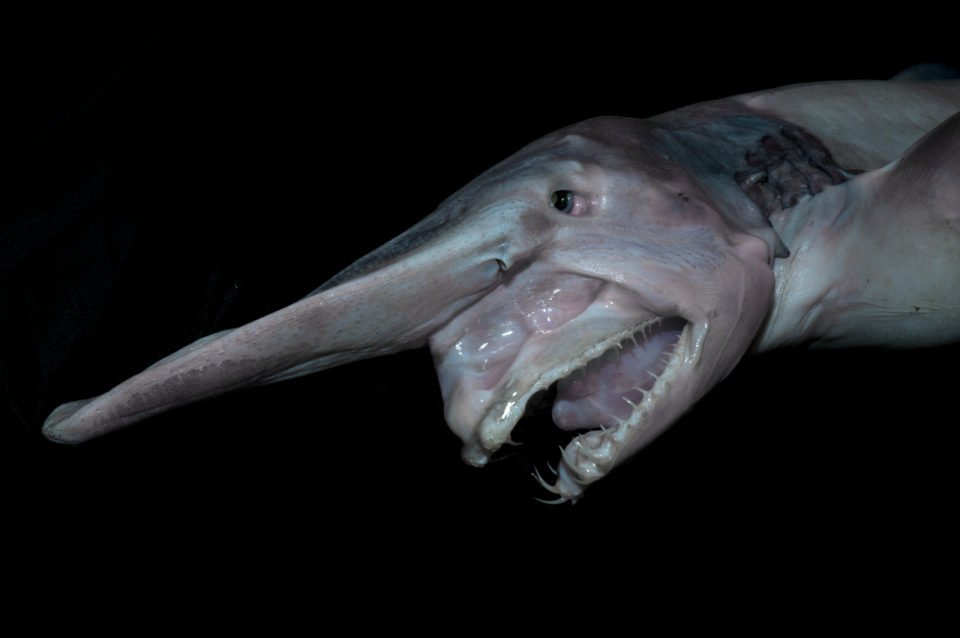
The goblin shark (Mitsukurina owstoni) is one of the most distinctive and enigmatic sharks known to science. Often described as a “living fossil,” this deep-sea species represents the sole surviving member of the family Mitsukurinidae, a lineage that dates back more than 120 million years. Its unusual appearance and rare encounters have made it an object of fascination, while its biology provides valuable insight into deep-ocean adaptation and shark evolution.
Don’t worry though. While it looks like it could eat you as a snack, the goblin shark does NOT attack humans. There have been zero instances of a goblin shark attack, mainly because they live deeper than any human would swim.
Taxonomy and Evolutionary Significance
The goblin shark belongs to the order Lamniformes, which also includes more familiar species such as the great white shark and the mako shark. Despite this relationship, the goblin shark diverged early from its relatives and retains many primitive anatomical traits. Fossil evidence suggests that ancestors of Mitsukurina were once more widespread and diverse, but environmental changes over geological time restricted the lineage to deep-water habitats.
Because of this evolutionary isolation, the goblin shark is especially important to scientists studying the early evolutionary pathways of modern sharks. Its anatomy preserves characteristics that have been modified or lost in more recently evolved species.
Physical Characteristics
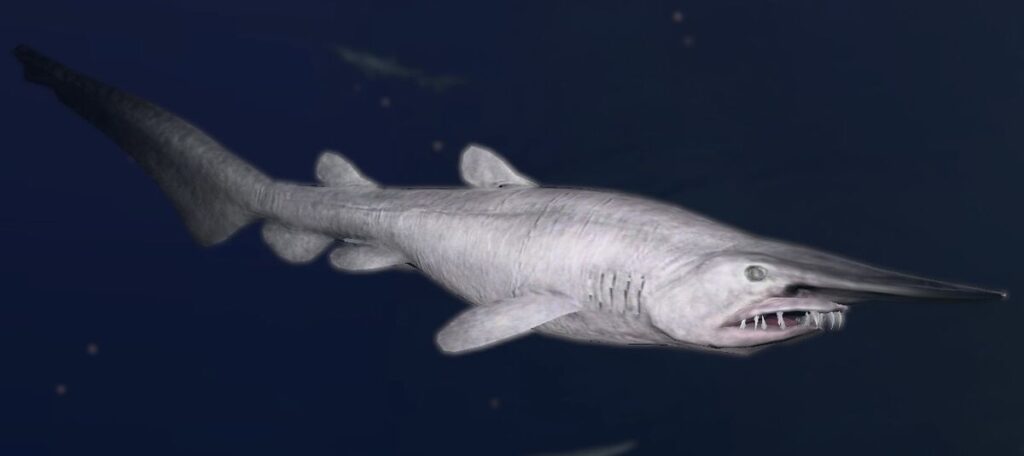
The goblin shark is immediately recognizable due to its elongated, flattened snout, which projects far beyond the mouth. This rostrum is densely packed with electroreceptors known as ampullae of Lorenzini, which allow the shark to detect the faint electrical signals produced by the muscles of prey animals. This adaptation is particularly useful in the deep sea, where light is scarce or entirely absent.
Another striking feature is the goblin shark’s jaw mechanism. When feeding, its jaws can rapidly extend forward, almost catapulting outward to seize prey. This protrusion is among the most extreme known in sharks and compensates for the species’ relatively slow swimming speed.
Goblin sharks typically range from 3 to 4 meters (10–13 feet) in length, though larger individuals have been reported. Their skin is pale pink to grayish in color, a result of translucent skin through which blood vessels are visible—an adaptation common among deep-sea animals.
Habitat and Distribution
Goblin sharks inhabit deep marine environments, generally at depths between 200 and 1,300 meters (roughly 650–4,300 feet). They are most commonly associated with continental slopes, submarine canyons, and seamounts.
Specimens have been recorded in the Atlantic, Pacific, and Indian Oceans, with notable observations near Japan, New Zealand, the Gulf of Mexico, and off the coasts of southern Africa. Because they live so deep and are rarely encountered by humans, much of their natural behavior remains poorly documented.
Feeding Ecology
The goblin shark is a benthopelagic predator, meaning it feeds both near the seafloor and in open water above it. Its diet consists primarily of deep-sea fishes, cephalopods (such as squid), and crustaceans.
Rather than pursuing prey over long distances, the goblin shark appears to rely on stealth and sensory detection. Once prey is located using electroreception, the shark deploys its highly specialized jaws to capture the animal in a rapid ambush. This feeding strategy is well suited to the energy-limited deep-sea environment, where efficient hunting is essential for survival.
Reproduction and Life History
Very little is known about goblin shark reproduction, largely because pregnant individuals and juveniles are rarely observed. Like many lamniform sharks, goblin sharks are believed to be ovoviviparous, meaning embryos develop inside eggs that hatch within the mother’s body, and live young are born.
The scarcity of reproductive data highlights the challenges of studying deep-sea species and underscores the importance of continued deep-ocean research.
Conservation Status and Scientific Importance
The goblin shark is not currently considered a targeted commercial species, and it is generally caught only as bycatch in deep-water fisheries. Due to limited data, conservation organizations classify it as a species of low concern but insufficiently studied. Its deep-sea habitat may offer some protection, but increasing human activity in deep-water environments could pose future risks.
Scientifically, the goblin shark remains invaluable. Each specimen contributes to understanding shark sensory biology, jaw mechanics, and deep-sea adaptation. As deep-ocean exploration technologies improve, researchers hope to learn more about this elusive species and its role in marine ecosystems.
The goblin shark stands as one of the ocean’s most extraordinary survivors—a species shaped by millions of years of evolution to thrive in darkness and depth. Though rarely seen, it offers critical insight into both the ancient past and the present functioning of deep-sea ecosystems. Continued research and responsible ocean stewardship are essential to ensure that this remarkable living relic endures for generations to come.
For more information about the goblin shark, visit these amazing resources: