Introduction: The Man Behind the Slaughter
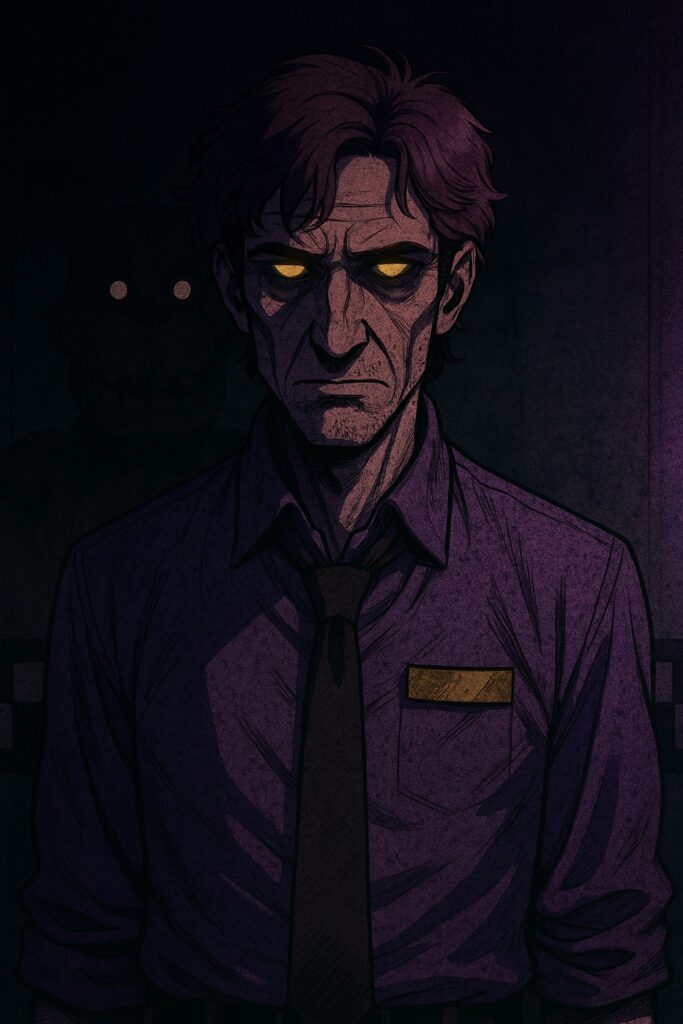
Within the haunted dreamscape of Five Nights at Freddy’s (FNAF), one shadow stretches farther and darker than all others: the figure of William Afton. His name—whispered, shrouded, and sometimes screamed—forms the axis of the franchise’s labyrinthine, recursive lore. He is the architect of agony, the scientist of souls, the purple phantom for whom death is not a terminus but a door flung open to ritual, technological horror, and endless rebirth. William Afton is not merely a villain. He is, in the mythic sense, an antithesis—a force whose choices crack reality, twist technology, corrupt innocence, and whose legacy shackles all others to the cycle of fear. This post seeks to render his chronicle in poetic, nightmarish hues: from his mortal creation to his myriad monstrous resurrections.
I. The Origin and Early Darkness
Genesis: The Co-Founder of Freddy’s Dreams
In the sepia-tinged memory of the FNAF universe, William Afton first emerges not as a killer, but as a genius and co-founder of Fredbear’s Family Diner, a business born of his partnership and rivalry with Henry Emily. Their collaborative dream was to conjure wonder and joy through animatronic spectacle. Yet, within William, the love of invention splinters into the hunger for control. The diner grows from humble beginnings—its animatronic duo, Fredbear and Spring Bonnie, are both marvels and portents of what will come.
As the business expands and spins off into Fazbear Entertainment, Inc., Afton’s restless creativity coalesces into the founding of Afton Robotics, LLC, later notorious for its clandestine, monstrous creations. William becomes the silent engineer not just of robots, but of rituals—synthesizing circuits and secrecy, curiosity and corruption.
The Descent: From Father to Harbinger
Beneath the mask of the entrepreneur, William’s moral fabric begins to curdle. The lore hints at a man divided: engineer and murderer, father and predator. The Crying Child, the youngest of the Aftons, endures the “Bite of ’83”—a catastrophic event instigated, directly or indirectly, by William’s neglect and toxic family climate. Trauma echoes as the boy is killed in Fredbear’s jaws, his death both mystery and omen. This trauma, many theorize, helps fracture William’s psyche further, catalyzing his obsession with life, death, and what lies between.
II. Monument of Evil: The Missing Children Incident
Timeline Table: William Afton’s Keys to Corruption
| Year | Event | Afton’s Form/Role | Key Theme |
|---|---|---|---|
| Early 1970s | William co-founds Fredbear’s Family Diner w/ Henry Emily | Human | Ambition, Innovation |
| 1983 | The Bite of ’83: Crying Child dies | Father | Family Rupture, Loss |
| 1985 | The Missing Children Incident: 5 children murdered | Serial Killer/”Purple Guy” | Ritual Murder, Corruption of Innocence |
| late 80s | Afton founds Afton Robotics, begins experiments with Remnant | Scientist, Engineer | Obsession, Technological Horror |
| Late 80s | Death of Elizabeth Afton by Circus Baby | Father | Tragedy, Obsession over Control |
| ???-1993 | Afton hides in Spring Bonnie suit, becomes “Springtrap” | Springtrap (undead) | Guilt, Ritual Consequence |
| 2020s | Digital resurrection as Glitchtrap/Burntrap | Glitchtrap, Burntrap | Technological Immortality, Ritual |
| Present | Afton’s continued digital/technological influence | Digital virus/Haunted AI | Endurance, Cycle of Evil |
Afton’s path is chiseled into legend by the Missing Children Incident: a midsummer horror in 1985, when five innocents vanish from Freddy Fazbear’s Pizza, lured by a familiar figure clad in a Spring Bonnie costume. William is the purple shadow seen by survivors, a master luring lambs to the slaughter. He exploits trust, donning the skin of innocence, and the helpless become his sacrificial lambs.
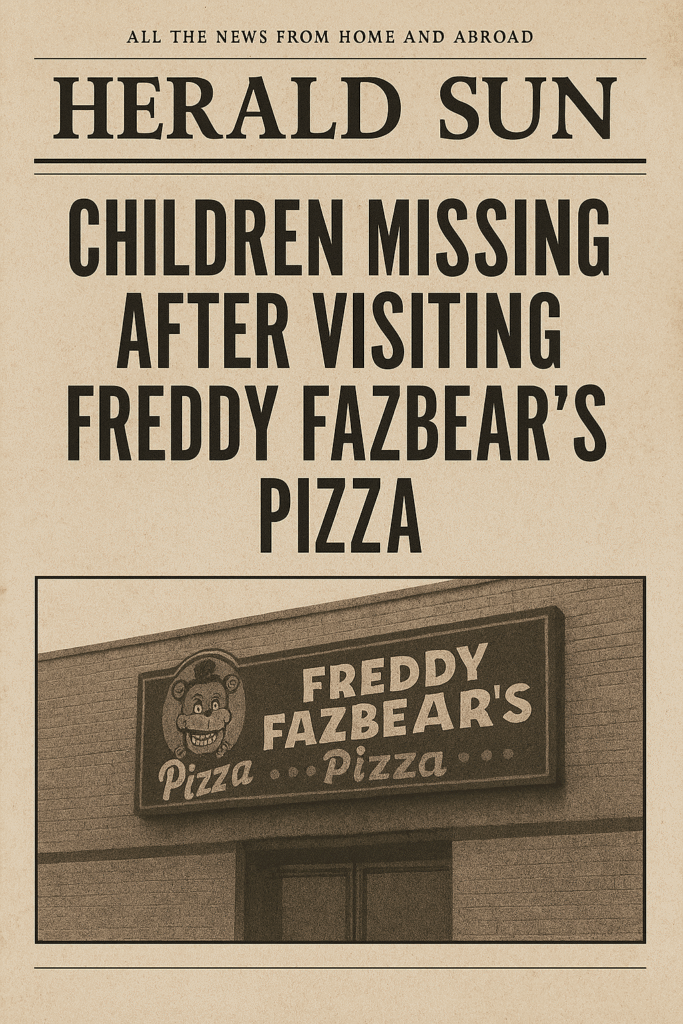
The aftermath is gruesome ritual—children’s bodies secreted within animatronic shells, the machines exuding the stench of “blood and mucus.” Hauntings follow, a cycle set: as innocence is corrupted, so the pizzeria rots from within. Afton’s ritual is not just the act of killing but the deliberate creation of a haunted microcosm. His deeds bind the spirits of his victims to the twisted, cold metal, chaining the restless dead to the mortal coil and setting the franchise’s mythic machinery into endless, vengeful motion.
III. Animatronics as Ascension and Prison
Afton Robotics LLC: Workshop of Abominations
The next arc of Afton’s nightmare is Afton Robotics, LLC—a front disguised as innovation, masking William’s pursuit of technological transcendence. In this shadow-lab, William engineers marvels: Circus Baby, Ballora, the Funtime crew—animatronics designed to charm, but also to capture and kill.
Each creation is an altar for new rituals: Circus Baby is equipped with a clawed claw “meant for ice cream,” but truly crafted for abduction. The technology Afton engineers is not neutral; it is intentionally corrupted, each circuit and servo a glyph in the grand, malignant ritual. The animatronics themselves become haunted, repositories of grief and violence.
- Circus Baby (Elizabeth Afton’s fate): In a motif both Oedipal and Electra-like, Afton programs Circus Baby to kill, despite knowing his own daughter Elizabeth is drawn to her. In a tragic episode, Baby’s stomach mechanism activates, and Elizabeth is consumed, killed by her father’s ambition for control and experimentation—her spirit then haunting the machine forevermore.
- Remnant: Through the “Scooper” device and other experimental forays, William extracts “remnant”—a supernatural, liquid metal substance binding consciousness to machinery. This acts both as scientific catalyst and mythical elixir of immortality, reinforcing themes of technological horror and failed transcendence.
Afton’s animatronics are thus not mere machines, but prison-temples, haunted crucibles of suffering, each housing souls torn from youth and life, fusing modern technology with the darkest rites imagined.
IV. The Ritual of the Springlock Suits and the Birth of Springtrap
Tempting Fate: The Springlock Failure
Afton’s ruin is inseparable from the Springlock Suit, a hybrid of costume and animatronic worn by staff for performances. The suit is a symbol—of temptation, of risk, and of irreversible consequence. Each is held together with fragile springlocks, which, when triggered by moisture or motion, snap and crush the wearer with a slow, grisly finality.
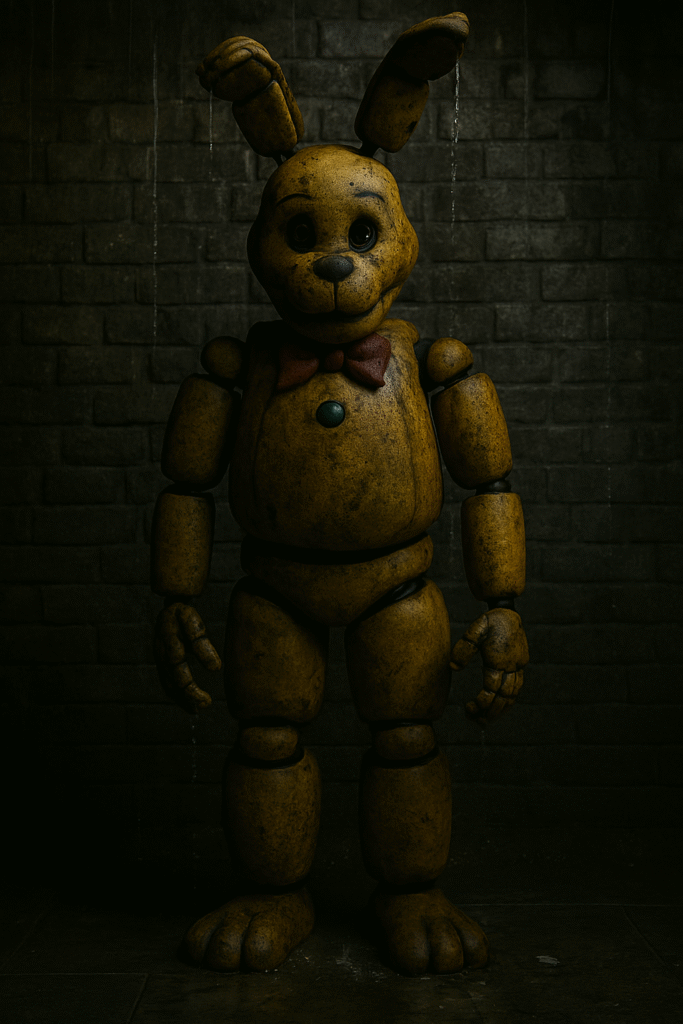
In one final act of desperation, after his crimes catch up with him and the spirits of the murdered children confront him within Freddy’s, William flees into the hidden room and dons the Spring Bonnie suit. The environment is damp, heavy with the storm’s breath; panic and guilt mingle, and the springlocks fail. Afton is mangled and impaled within, unable to cry out—a poetic justice, the scientist now a screaming cog in the machinery of his own sins. He becomes one with the suit—a monstrous unity, both puppet and puppeteer: Springtrap.
This is archetypal, a cautionary tale as old as Icarus—the man who sought to master life and death becomes ensnared by the very mechanism he made to deceive, control, and destroy. He is entombed in his work, body rotting but soul entwined with wire, blood, and agony.
V. Immortality and Digital Purgatory: Afton’s Later Incarnations
As the years coil forward, Afton’s legacy grotesquely evolves. Decades after he is walled away, his body transforms from menacing relic to resurrected horror. His forms multiply, each a permutation of his pursuit for eternal dominion:
From Springtrap to Scraptrap
Vanquished in the fire of Fazbear’s Fright, he returns, battered and more monstrous as Scraptrap. Part necrotic flesh, part scavenged machinery, he stalks the simulation of salvation crafted as a trap by Henry Emily. Yet, true to his refrain—”I always come back“—Springtrap/Scraptrap’s endurance feels mythic, a Sisyphean rejection of mortality.
Glitchtrap: Digital Demon
But William Afton is not content to haunt the physical. In Five Nights at Freddy’s: Help Wanted, he becomes Glitchtrap—a digital virus, a rabbit-masked shadow flickering in code, infecting virtual reality with his essence. Glitchtrap is the modern ghost, an avatar transcending the boundary between software and haunting. His digital ritual is insidious: he possesses, manipulates, and returns via the internet’s labyrinthine passageways, leaving behind a meme-trail and a digital cult.
Glitchtrap convinces, seduces, and “reanimates” others (notably the follower Vanny), carrying out his will in the real world, all the while acting as ambassador for the most contemporary form of technological horror. He is the virus of unending evil, the meme-laden intruder of modern anxiety.
Burntrap and the Ultimate Cycle
Burntrap, glimpsed in Security Breach, represents Afton’s final (or most recent) metamorphosis—still battered, more fire-scarred, yet doggedly persistent. As Burntrap, he fuses the motifs of entropy and the unholy sacrament of resurrection: animated by loathing, hunger for control, and a remnant of digital evil. His ability to possess and corrupt the newest animatronics speaks to the inescapable grip of the old evil upon the latest generation.
VI. Ritual, Corruption, and Technological Horror
The Ritual Motif
Afton’s acts transcend mere killing; at every juncture, his violence is ritualistic. Each murder incorporates the elements of ancient sacrifice: innocence lured and slain, souls bound to artificial vessels, and a haunted edifice becoming an altar of perpetual repetition. He chants mantras—“I always come back”—which become invocations. His surgeries with remnant, his experiments on the living and the dead, are rites in pursuit of immortality.
Corruption: From Man to Monster, from Metal to Malice
Each act undertaken by William Afton represents not only a step further from humanity, but a spreading rot—reaching his family, business, and victims in contaminating waves. His business partner, Henry Emily, is transformed from collaborator to Nemesis; the Afton family is annihilated or cruelly repurposed. His children—Michael, Elizabeth, the Crying Child—become either puppets or monsters, all compulsively enacting his ruinous dramas. The corruption of the mundane into the horrific becomes signature: the friendly stage is a tomb, the entertainer is a torturer, the creator a destroyer.
The Horror of Technology
Afton’s legend is as much about technological terror as it is about ghosts. He transforms modern wonders—animatronics, VR games, robotics—into ritualistic devices of suffering. The genre thus pivots from simple possession to techno-horror: the machinery is not haunted in isolation, but constructed to be haunted; every circuit is a hungry eye, each program capable of corruption. The digital world, which should be frictionless and abstract, is infected in his hands—Glitchtrap, Burntrap, and every hacked circuit board a locus of dread for the children of the “digital age”.
VII. The Afton Family and Perpetual Legacy
The Broken House: Family as Mirror and Victim
William’s familial relationships underscore the core themes of the mythos: corruption of innocence, the legacy of sin, and the hopeless longing for redemption. Michael Afton, the dutiful, suffering son, attempts to “put them back together,” to rescue his siblings and undo the pain, but is martyred, turned into a hollow, shambling vessel animated by remnant. Elizabeth, curious and ambitious, is destroyed by her father’s creation and made into something monstrous by paternal neglect, becoming Circus Baby—a blend of nostalgia and hatred. The Crying Child’s trauma, the result of both fraternal and paternal dysfunction, acts as the first in a cascade of tragedies.
Afton’s legacy poisons all. Even those who seek to destroy him, like Henry Emily, become obsessed with undoing his evil—a pattern that repeats ritualistically. As long as Fazbear’s resurrection cycles repeat, so does William Afton’s influence endure: the technological curse, the familial schism, the endless haunting.
The Rivalry with Henry Emily: Order versus Entropy
The rivalry and betrayal crowning William’s tale is his relationship with Henry Emily. Initially partners, their paths diverge—Henry ultimately sacrificing himself, orchestrating the final “purification” fire to end William’s curse. The two men become binary opposites in the lore: creator and destroyer, restore and corruptor, echoing mythic pairs stretching back to ancient stories.
VIII. Canonical Sources, Theories, and Fandom Controversy
The web of William Afton’s story sprawls across games, novels, films, fandom forums, and animated shorts. The boundaries are deliberately blurred—a method that both engages and frustrates the fanbase. Canonical sources, often disguised as mini-games and hidden clues, layer the narrative with ambiguity. Theories proliferate, dissecting the order of murders, the identity of the Crying Child, the mechanics of remnant, and the truth behind the Afton lineage. Disagreement is itself a ritual as fundamental as any of Afton’s mechanical rites—the cycle of theory, revelation, revision, and debate loops in endless recursion.
Fan interpretations, such as the “MikeBro vs MikeVictim” debate and the nature of Glitchtrap’s digitality, have become near-canonical through sheer engagement. The mythos, intentionally or not, is sustained by its ambiguities and the hunger they produce. This has allowed the narrative of Afton to remain flexible, ever-mutable, and endlessly revenant. The story’s very chaos is its own form of ritual—an anarchic answer to William’s own obsession with control.
IX. The Mythic and Poetic Nature of Afton’s Tale
William Afton is no longer just a villain; he’s FNAF’s fallen Lucifer, its Frankenstein, its Prometheus in reverse. Each of his forms—purple killer, undying Springtrap, digital Glitchtrap—tells a recursive myth of hubris punished, of unchecked curiosity becoming curse. He is the nightmare from which Freddy’s can never awaken, the bloodied finger forever smearing the curtain between childhood fantasy and adult dread.
His refrain—“I always come back”—is both boasted and bemoaned, a prophecy fulfilled by design and by failing. He invades the digital cloud after the ashes of the physical, possessing not just hardware but hearts. In Afton, all of horror’s grand themes converge: the seduction of immortality, the inevitability of consequence, the corruption of creativity, the futility of redemption. Each night that falls in a Fazbear warehouse, it is his silhouette that lengthens.
He is the ritualised echo in every child’s scream, the technological dread singing through every servo; the corruption that will not die because, in the end, Afton is the myth by which the FNAF world defines its fear. And maybe ours, too.
Conclusion: The Unending Night
As the fans and theorists keep vigil—mining code, piecing tapes together, charting timelines—William Afton persists. His narrative, coiled and recursive, ensures that the horror never truly resolves. He has become both man and meme, curse and code: parent to every animatronic, every haunted song, every new iteration of dread. In this mythic liminal space, souls and circuits fuse; ritual and revenge repeat. For as long as childhood wonder can be corrupted by adult ambition, and as long as story inspires fear, he—the purple man, the hunger in the wires—will always come back.
Author’s Note
All images featured in this post were generated using AI tools and are original interpretations inspired by horror game themes. They do not depict official characters or assets from the Five Nights at Freddy’s franchise. This content is not affiliated with, endorsed by, or representative of Scott Cawthon or the creators of FNAF.

Five Nights at Freddy’s: Security Breach (Nintendo Switch)
Explore the aftermath of Afton’s legacy in a neon-drenched survival horror—where echoes of his influence still haunt the halls.
Five Nights at Freddy’s (Blu-ray + DVD + Digital)
Witness the cinematic retelling of the mythos that began with Afton’s twisted ambition—perfect for lore deep-dives and eerie rewatches.
Freddy Fazbear Animatronic Bundle
Bring the animatronic legacy home—this bundle channels the haunting charm of Freddy’s stage, where Afton’s plans first took shape.
Freddy Fazbear Neon Sign
Illuminate your space with the glow of nostalgia and menace—this sign evokes the eerie ambiance of Freddy’s after dark.
Freddy Funko Pop!
A collectible tribute to the franchise’s most iconic face—Freddy stands as both mascot and myth, forever tied to Afton’s rise and fall.
FNAF Graphic Novel Trilogy Box Set
Dive into the illustrated lore that expands Afton’s twisted tale—perfect for fans who crave deeper narrative threads and haunting visuals.
FNAF Night of Frights! Board Game
Recreate the tension and terror of Freddy’s in tabletop form—ideal for game nights that echo the suspense of Afton’s legacy.
I really like what you guys are up too. This kind of clever work and exposure!
Keep up the terrific works guys I’ve you guys to my personal blogroll.