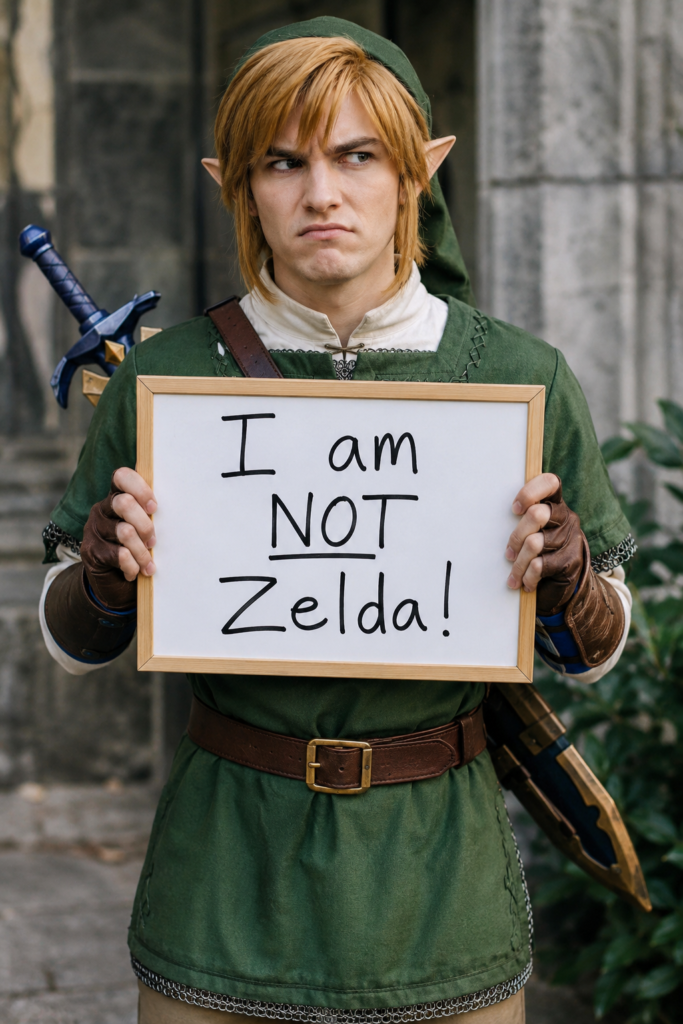
“My name is NOT Zelda” ~Link, probably… numerous times.
My Name Is NOT Zelda
For four decades, our silent, green-clad hero has endured one of gaming’s most persistent cases of mistaken identity. Somewhere along the way, the world collectively decided that the blonde elf-boy in the tunic must be Zelda, and Link, ever the stoic adventurer, just kept swinging his sword and hoping someone would eventually read the title screen.
But the truth is far more interesting than the meme. Link isn’t just “the guy who isn’t Zelda”. He’s one of the most enduring archetypes in modern storytelling: the reincarnating hero, the chosen vessel, the quiet courage that rises whenever Hyrule needs a heartbeat of light. And he isn’t even an elf, but a race known as Hylian.
His origins go deeper, and stranger, than most people realize. So let’s get into the lore that is Link and understand the psychology behind why everyone calls him the princess.
The Basics of Link & How He Became “Zelda”
Link’s story begins with something simple. He is a Hylian, a race known for its pointed ears, long lifespans, and quiet connections to the divine forces that shape Hyrule. Every version of him across the timeline carries the same essence: a courageous spirit that rises whenever the world needs someone to stand between danger and the fragile light that keeps everything alive. He is not an elf, not a fairy, and not a wandering woodland sprite. He is a Hylian hero, whose soul keeps returning in new forms, each one shaped by the era he is born into.
Despite all of that depth, Link somehow became known by the wrong name. When the first games arrived, many players assumed that the character on the screen must be Zelda. The title said The Legend of Zelda, and people were used to games named after their protagonists. Mario appears in Mario. Kirby is found in Kirby. Sonic is in Sonic the Hedgehog. It felt natural to assume the same pattern applied here. Link, being silent and expressive only through movement, never corrected anyone. The misunderstanding spread from one player to another, especially among kids teaching other kids how to play. Zelda was the only name anyone saw, so it became the name everyone used.
The mix of a quiet hero, an unfamiliar fantasy world, and a title centered on the princess created a perfect storm of confusion. Even now, decades later, people who have never touched a Zelda game still call him Zelda, forty years later. It has become part of the cultural joke, a misunderstanding so persistent that it almost feels like a rite of passage. Link as “Zelda” captures the humor, the history and the gentle exasperation of a hero who has been politely correcting the world for 40 years now. Yet, our stoic pointed-eared evergreen hero is patient enough to continue to do so for generations to come. His nickname of “Zelda”, though belonging to the princess, does not seem to be going away anytime soon.
All that said, who exactly is Link?
Who Link Is
Link is, at his core, the embodiment of courage in a world that is always on the edge of losing its light. He is a Hylian boy who becomes a hero, not because he seeks glory, but because something ancient within him answers the call every time Hyrule begins to tremble. Across the long and tangled timeline of the series, Link appears again and again as a new person with a familiar spirit. He is born into different families, raised in different corners of the world, and shaped by different eras, yet something constant threads through each incarnation. It is the quiet bravery that rises when danger looms, the instinct to protect, and the willingness to step forward when no one else can.
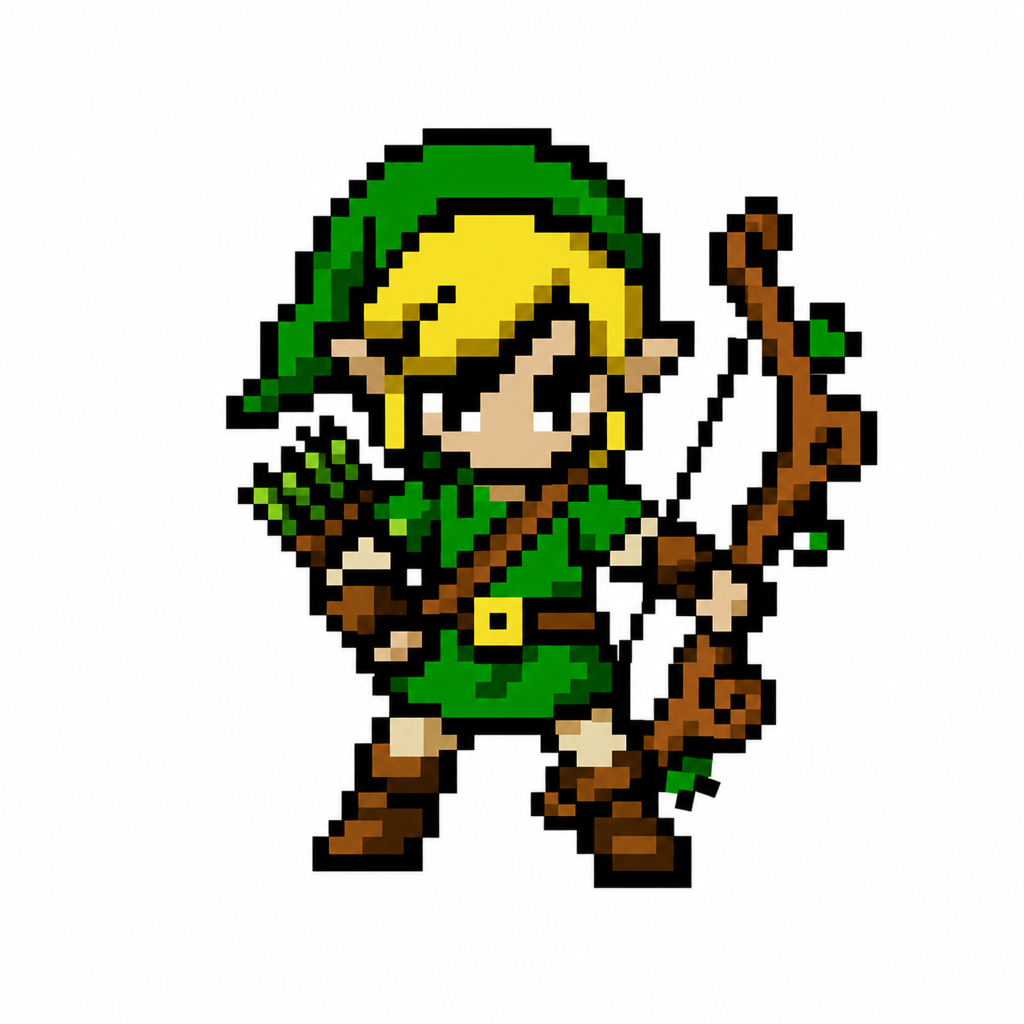
His origins stretch back to the earliest stories of Hyrule, where the gods shaped the world and left behind relics of immense power. In those first ages, a hero emerged who stood against the forces that threatened to unravel creation. That first Link set the pattern for every version that followed. His soul became a vessel for the Hero’s Spirit, a kind of mythic inheritance that reawakens whenever the balance of the world tilts too far toward darkness. Each new Link is his own person, with his own life, yet each carries the echo of that ancient courage.
This is why Link feels both familiar and new in every game. He is not a single continuous character, but a lineage of heroes connected by something deeper than blood. He is shaped by prophecy, by destiny and by the choices he makes in each lifetime. He is the boy who leaves home because someone must. He is the young man who steps into danger because the world is asking for him. He is the quiet presence who becomes the center of a legend without ever speaking a word.
Understanding who Link is means understanding that he is both an individual and an archetype. He is the hero who keeps returning, the spirit that refuses to fade, and the steady heartbeat of Hyrule’s long story. That is how he came into being, and why he continues to rise over and over again, no matter how many centuries pass.
Link’s Timeline
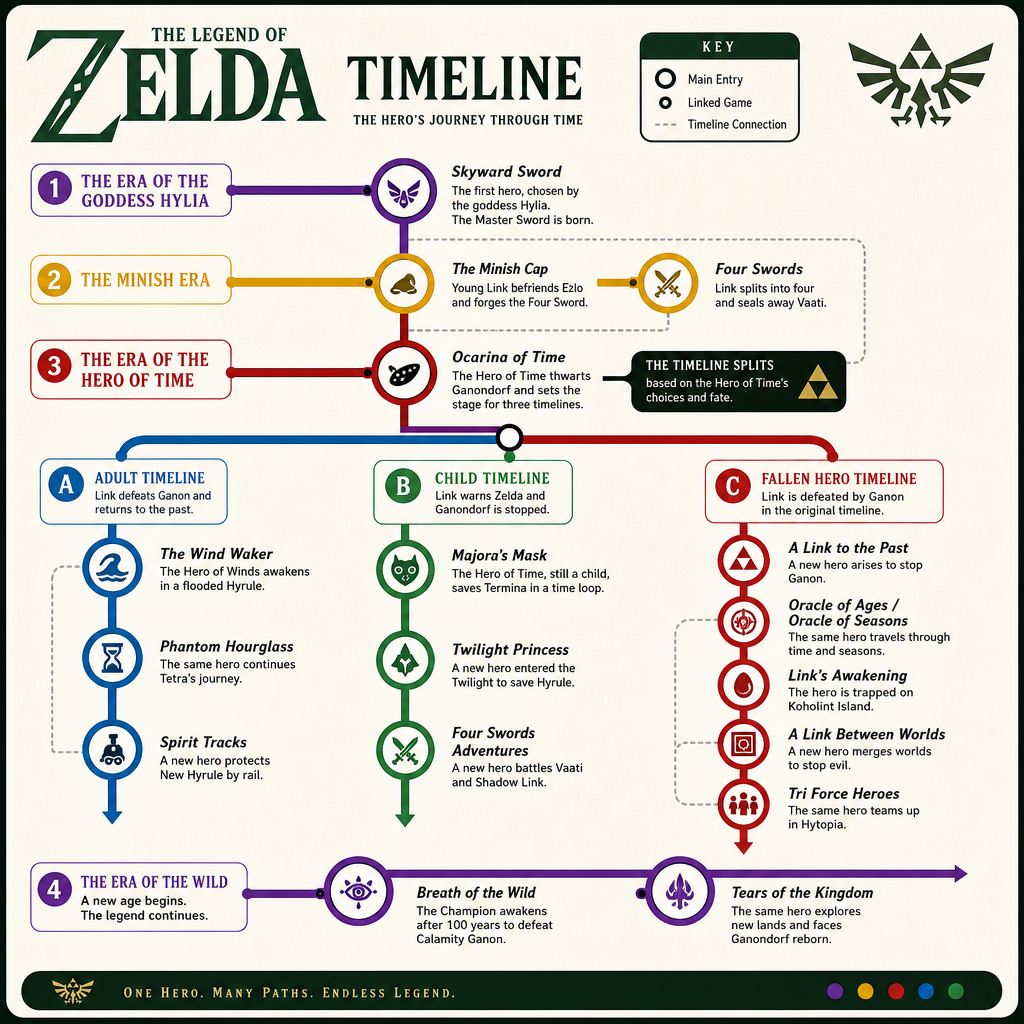
An Overview of Link’s Timeline
We first meet Link in the original Legend of Zelda for the Nintendo Entertainment System, where he appears as a young hero wandering a dangerous and unfamiliar Hyrule. There is no introduction, no explanation, and no guiding hand. He simply exists in a world already in crisis, and the player discovers who he is by watching him rise to meet the challenges placed before him. This early version of Link sets the tone for every incarnation that follows. He is quiet, determined, and willing to step into danger long before he understands the full weight of the journey ahead.
As the series continues, Link reappears in new eras that expand the history of Hyrule. In A Link to the Past, he becomes part of a deeper mythos that ties him to ancient conflicts and forgotten realms. In Ocarina of Time, he grows from a child into a hero whose actions are so significant that they cause history itself to branch. One version of Link moves forward into adulthood and leaves behind a world that must survive without him. Another returns to childhood and prevents the disaster he once lived through. A third timeline imagines a world where he falls in battle, and new heroes must rise in the shadow of his defeat. Each of these paths becomes its own strand of the larger legend, and each one carries a different version of Link shaped by the choices made in that pivotal moment.
Other eras reveal different sides of him. In Link’s Awakening, he appears far from Hyrule, shipwrecked on a mysterious island where the boundaries between dream and reality blur. In The Wind Waker, he emerges in a world swallowed by the sea, where the memory of the Hero of Time has faded into myth. And in Twilight Princess, he undergoes one of the most startling transformations in the entire series. When the kingdom is pulled into the Twilight, Link’s spirit reacts to the magic of that realm and then takes the form of a wolf. Link essentially becomes a werewolf. It is strange, instinctive, and almost unsettling, as if the heroic spirit inside him is being filtered through something ancient and primal. That shape-shifted version of Link moves through the story with a rawness that players had never seen before, and it adds a surreal layer to the legend that still stands out today.
Each game places him in a new context, yet that same spirit of courage threads through every incarnation, creating a sense of continuity, even when the worlds around him look nothing alike.
The timeline eventually stretches into the distant future, where the ruins of ancient civilizations lie buried beneath wild landscapes. In Breath of the Wild and Tears of the Kingdom, Link awakens once more, this time as a champion returning from a century of sleep. Even in this far-flung era, surrounded by forgotten technology and fractured kingdoms, he carries the same quiet resolve that has defined him since the earliest days of legend. His presence ties the entire history together, not through a single lifetime, but through a repeating cycle of courage that rises whenever Hyrule needs it most.
Seen across all these games, Link’s timeline becomes a tapestry of eras, worlds and possibilities. Each version of him stands alone, yet all of them echo the same heroic spirit. That is the overarching shape of his journey, and why the legend continues to grow rather than ending in one place and time.

The Legend of Zelda: Hyrule Historia
The book that turned Zelda lore obsession into a full-time personality trait. If your readers finish your post wanting timeline answers immediately, this is the rabbit hole.
The Legend of Zelda Encyclopedia
For the readers who thought they knew Zelda lore… until they realized Hyrule has enough mythology to rival actual epics.
The Legend of Zelda: Art & Artifacts
Concept art, ancient designs, forgotten details. It’s basically visual proof that Zelda has always been fantasy art at its peak.
The Legend of Zelda: Tears of the Kingdom – The Complete Official Guide
Everyone says they’ll “just explore naturally” until they miss half the map and start googling shrine locations at 2AM.
Because at some point every Zelda fan has imagined themselves pulling the Master Sword. This is the closest you’ll get without being summoned by destiny itself.