The Ocean as a Mind
The first time you watch a dolphin glide beneath the surface, you feel the strangeness of it. The water folds around them like a second skin, and they move with a certainty that suggests they are not navigating the ocean so much as inhabiting it the way a thought inhabits a mind. People often talk about dolphin intelligence in terms of tricks, problem solving, or social bonds, but those are only the visible ripples. The deeper truth is that dolphins live in a world shaped by sound, and that world produces a kind of consciousness that is profoundly different from our own. Studies of echolocation suggest that dolphins can identify objects with remarkable precision, distinguishing differences in material, density, and internal structure. To understand dolphins, you have to imagine what it means to think in echoes.

You have to imagine a mind that does not picture the world but hears it into being.
A World Built from Vibrations
Humans are visual creatures. We build our inner worlds from images, metaphors, and imagined scenes. Even our language reflects this bias. We say things like “I see what you mean” or “look at it this way.” Our thoughts are arranged like paintings or diagrams. We navigate life through imagined sight.
Dolphins do not.
A dolphin’s primary sense is not vision but sound. Their echolocation is not a backup system or a clever trick. It is the foundation of their perception. When a dolphin sends out a click, the sound travels through water, strikes an object, and returns with information so detailed it borders on unbelievable. Hardness, density, shape, movement, even the internal structure of a fish or the hollow space inside a shell all return to them in the echo.
To a dolphin, the world is not seen. It is revealed.
Imagine thinking in those revelations. Imagine your thoughts arriving as pulses of spatial information, each one a three‑dimensional map of your surroundings. Where we imagine pictures, dolphins imagine structures. Where we visualize, they resonate.
The Shape of a Dolphin Thought
If you could step inside a dolphin’s mind for a moment, you would not find a gallery of images. You would find a shifting architecture of sound. A dolphin does not picture a fish. It perceives the fish’s outline, the firmness of its muscles, the flutter of its heartbeat, and the way its body displaces water. All of that arrives in a single echo.
This creates a kind of thinking that is less about appearance and more about essence. Dolphins understand objects by their internal truth rather than their surface. A fish is not defined by its color or pattern but by the way its body is built. A rock is not a shape but a density. A human swimmer is not a silhouette but a collection of bones, lungs, and motion.
This is not imagination as we know it. It is a sensory philosophy.
Sound as Social Thought
Dolphins do not only use sound to perceive the world. They use it to understand one another. Their clicks and whistles are not just communication but cognition shared across bodies. When one dolphin echolocates another, the returning echo carries information about emotional state, physical condition, and movement intention. It is as if they can hear each other’s posture, tension, and readiness.
This creates a social world built from acoustic transparency. Dolphins perceive one another through layers of sound and movement invisible to human senses. Their friendships, alliances, and rivalries are shaped by a constant exchange of internal truth. Humans rely on facial expressions and tone of voice. Dolphins rely on the resonance of bodies in motion.

To think socially as a dolphin is to think in shared soundscapes. Their group intelligence is not a metaphor. It is a literal merging of sensory worlds.
When Perception Becomes Philosophy
The way a creature perceives the world shapes the way it understands it. Human consciousness is built from sight, metaphor, and narrative. Dolphin consciousness is built from sound, structure, and spatial resonance. This difference is not small. It is a shift in the architecture of thought.
A dolphin’s sense of self is likely more fluid than ours. They experience their environment as a continuous field of echoes, and their own bodies are part of that field. The boundary between self and world is softer. The ocean is not a backdrop but an extension of their awareness.
This raises a profound question. If your thoughts are shaped by sound, and sound is shaped by the environment, then where does the mind end and the world begin?
For dolphins, the answer may be that it never truly does.
The Ocean as a Cognitive Landscape
Water carries sound far more efficiently than air. A dolphin can sense objects hundreds of meters away. They can track the movement of fish they cannot see. They can sense the hollow space inside a coral head or the shifting sand beneath a buried stingray. Their world is full of hidden layers that unfold through sound.
This creates a consciousness that is not limited to the immediate moment. Dolphins can anticipate movement by the way echoes change. They can sense danger before it appears. They can read the ocean like a living text.
Their intelligence is not simply cleverness. It is a deep attunement to the physics of their world.
The Story of a Dolphin Encounter
Imagine a dolphin approaching a person. The human sees a sleek gray shape cutting through the water. The dolphin hears a hollow cylinder of lungs, the density of bones, the flutter of a heartbeat, and the shifting of air in the environment. It may detect subtle differences in muscle tension, movement, and rhythm that humans would never notice. Through echolocation, it can sense whether the person is calm or frightened. It can tell whether they are healthy or struggling. To the dolphin, the encounter is not a visual moment but a complete acoustic portrait.
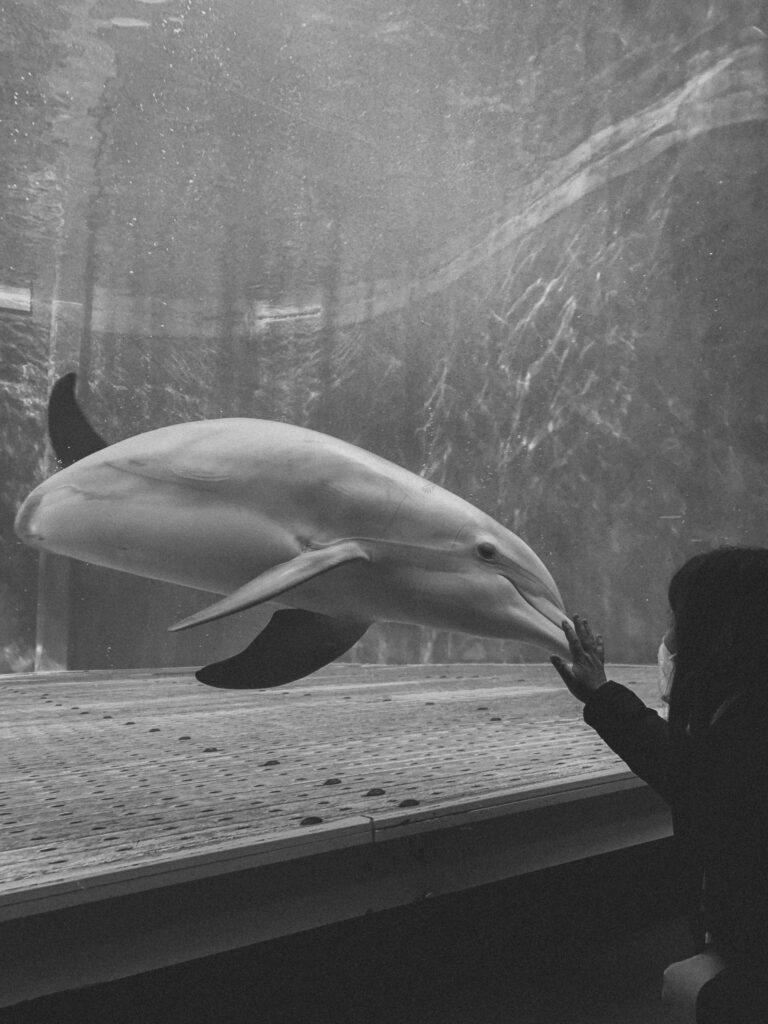
This is not magic. It is perception elevated to philosophy.
Thinking Without Images
Humans often assume that intelligence must look like ours. We imagine that other species think in pictures or words. But dolphins remind us that consciousness is not a single path. It is a spectrum shaped by the senses available to each species.
A dolphin’s inner world is not a movie. It is a symphony of spatial echoes. Their thoughts are not images but structures. Their memories are not snapshots but resonant patterns. Their understanding of the world is not visual but acoustic.
This challenges our assumptions about what intelligence is. It suggests that thought itself can take forms we have barely begun to imagine.
The Future of Understanding Dolphin Minds
Scientists are only beginning to explore the depth of dolphin cognition. New research into acoustic communication, neural architecture, and social behavior suggests that dolphins may possess forms of intelligence that do not fit neatly into human categories. They may think in ways that are not translatable into human language because their thoughts are built from sensory experiences we do not share.
To understand dolphins, we must be willing to step outside our visual bias. We must imagine a world where sound is not just heard but felt, mapped, and understood as the primary medium of thought.
The more we learn, the more we realize that dolphin intelligence is not a mirror of our own. It is something unique, something shaped by the ocean, something resonant and fluid and profoundly different.
A Mind Made of Echoes
When you watch a dolphin leap from the water, it is easy to admire the grace of the movement. But the real wonder lies beneath the surface, in the way they perceive the world and the way that perception shapes their consciousness.

Dolphins think through sound. They build their inner worlds from echoes. They understand their environment through resonance. Their intelligence is not a reflection of ours but a reminder that the universe holds many ways of knowing.
To think like a dolphin is to think in vibrations. It is to understand the world not by looking at it but by listening to its structure. It is to inhabit a consciousness shaped by the ocean itself.
And in that difference lies the beauty of their minds.

Crystal Dolphin Orb – 3D Laser-Etched Glass Sculpture
Two dolphins suspended in light, circling a shared heart inside glass. A captured moment of connection—like a feeling you can’t quite see, only sense through its shape. Once it’s gone, it’s gone.
Majestic Dolphins: A Premium Visual Journey
A visual descent into a world that does not speak in images but in movement, light, and intelligence just beneath understanding. Some perspectives do not just inform you. They change how you see.
A moment turned into visible structure. A waveform that traces sound the way dolphins trace the ocean—turning what cannot be seen into something spatial and real. In a world where perception is usually visual, this is what sound looks like when it becomes form.
Turn a room into moving water. Shifting light that mimics the ocean’s hidden motion, like seeing the surface of a world that is usually only felt. A small escape into a different way of perceiving space.
Not an interpretation of intelligence, just the feeling of connection after everything else. When the ideas fade, this is what remains: something soft to hold onto.