Some birds are content to quietly hunt for dinner. They catch a fish, eat it, and go about their business like respectable members of bird society.
The Frigatebird has apparently decided that sounds like way too much work.
High above warm tropical and subtropical oceans, this remarkable seabird cruises the skies on enormous wings, watching everything happening below. Sometimes it catches its own food. Sometimes it snatches a meal from the ocean’s surface. And sometimes it spots another bird carrying a perfectly good fish and basically says, “You know what? I’ll take that.”
Then the chase begins.
Fast, agile, and ridiculously good in the air, the Frigatebird can harass another seabird until its victim drops or regurgitates its meal. The Frigatebird swoops in and grabs the falling food, often before it reaches the water. It is a behavior called kleptoparasitism, which is the scientific way of saying, “Give me your lunch.”
If there were tiny eye patches available for birds, these guys would absolutely deserve one.
Meet the Frigatebird
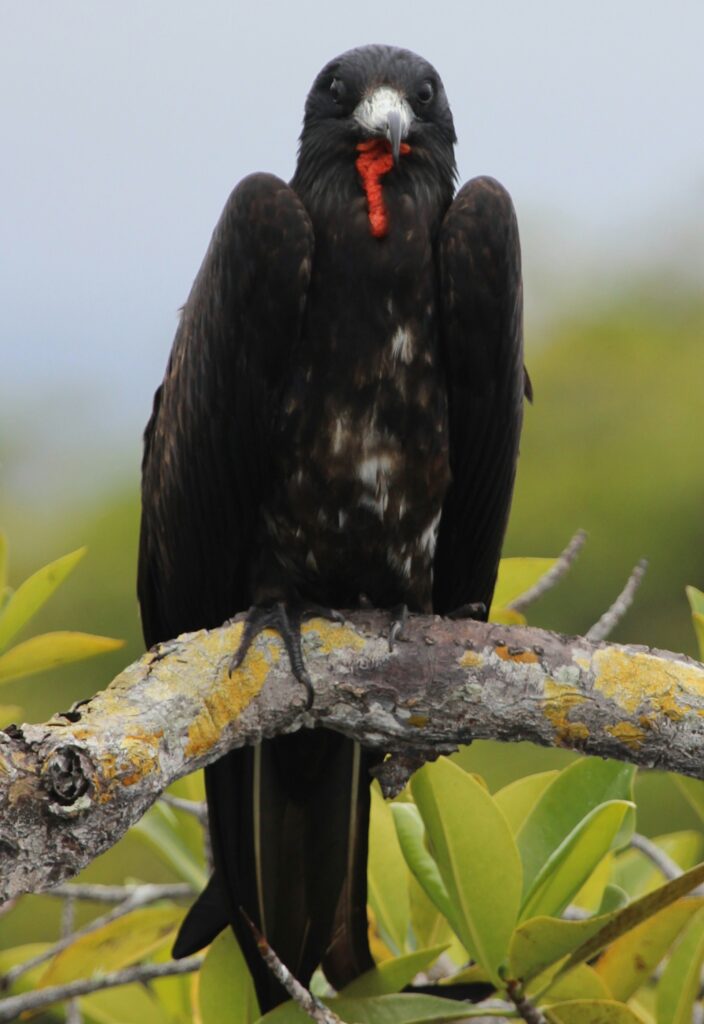
A Frigatebird is not exactly difficult to recognize once you know what you’re looking for. There are five living species, all belonging to the genus Fregata. They are found around tropical and subtropical oceans, and they share the same general dramatic appearance: long pointed wings, a deeply forked tail, and a long bill with a hook at the end.
Translation: this bird looks like it was designed by somebody who thought regular seabirds needed more flair.
That forked tail is especially noticeable when a Frigatebird is flying. The bird can adjust it as it maneuvers through the air, helping create the incredible agility that comes in very handy when your dinner plans occasionally involve chasing somebody else’s dinner.
Their bodies are surprisingly lightweight compared with those huge wings. That combination makes the Frigatebird beautifully suited for soaring. Instead of constantly flapping and burning energy, it can take advantage of rising air and wind currents.
So while other birds may look like they are working very hard to get somewhere, a Frigatebird can appear to be casually floating overhead. Effortlessly. Probably judging everyone.
Why Is It Called a Pirate?
The pirate reputation comes from one of the Frigatebird’s most famous behaviors: stealing food from other seabirds.
Scientists call this kleptoparasitism. Frigatebirds may pursue birds such as boobies and tropic birds that have already caught a meal. During an aerial chase, a Frigatebird can grab at the other bird’s tail or wing with its hooked bill. Under enough pressure, the unlucky bird may give up its food. The Frigatebird then releases its victim and races after the falling meal.
Rude? A little.
Impressive? Oh, absolutely.
Imagine catching a fish, hauling yourself back into the air, and beginning your trip home only to look behind you and discover a giant winged bandit gaining on you.
That is a very bad Tuesday.
The amazing part is the precision involved. The stolen fish is not sitting politely on a plate. It is falling toward the ocean while everybody involved is flying. The Frigatebird has to maneuver into position and grab its prize in midair. That takes excellent timing and extraordinary control.
There is also an important detail that sometimes gets lost in all the pirate jokes. Frigatebirds do not rely entirely on robbery for food. They hunt for themselves too, taking prey including squid and flying fish from around the ocean surface. So perhaps “opportunistic pirate” is more accurate.
Still, it is much less fun to say.
A Frigatebird Is Built for the Sky
The ocean may be where much of its food comes from, but the sky is where the Frigatebird really shines.
These birds have exceptionally long wings relative to their light bodies. Across the family, wingspans can reach about 2.3 meters, or 7.5 feet.
Seven and a half feet.
That is less “cute little birdie” and more “excuse me, something enormous just passed over my head.”
Those wings allow Frigatebirds to soar for long periods while using air currents to their advantage. Rather than muscling through the sky with nonstop flapping, they can glide with remarkable efficiency.
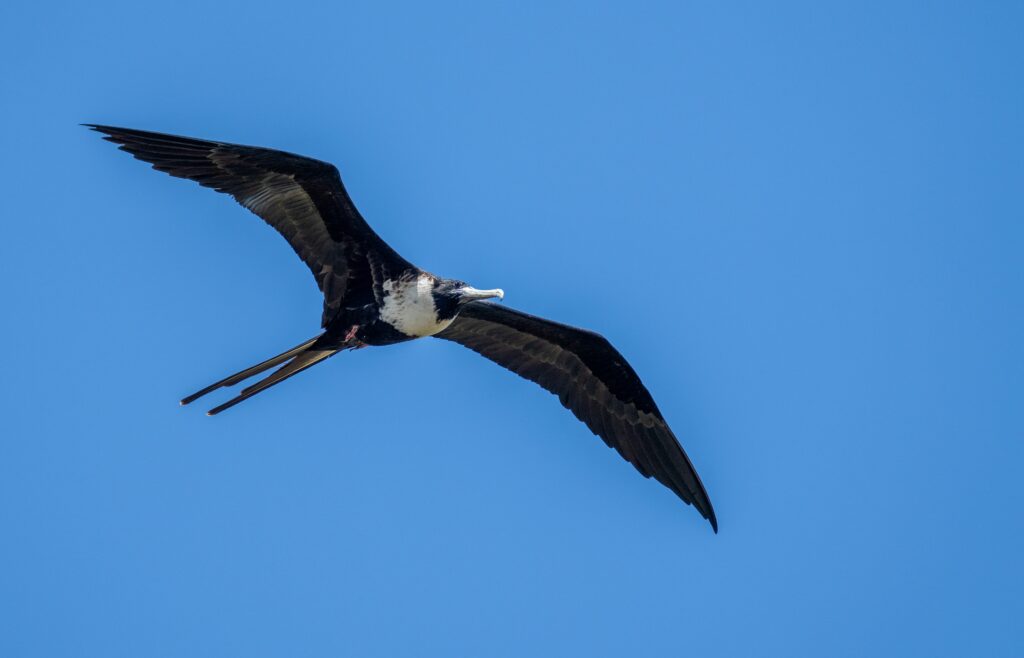
And researchers studying great frigatebirds have documented some astonishing journeys. Tracking research has shown these birds can remain aloft continuously for more than two months, taking advantage of atmospheric conditions as they travel over the ocean.
Meanwhile, I get tired carrying groceries in from the bus. Just saying.
The Aerial Pirate Has One Very Strange Problem
For a bird so closely connected to the ocean, the Frigatebird has an awkward limitation: It is not built for casually floating around on the water.
Unlike many seabirds, frigatebirds do not have the same waterproof plumage that would allow them to happily bob around at sea. This is one reason they take food from at or above the surface rather than routinely diving into the water after it.
That changes the whole hunting game. If diving is not a good option, you had better become extremely talented at getting food without diving. And that is exactly what the Frigatebird has done. It can snatch prey near the surface, pursue flying fish, and, of course, make use of the occasional unauthorized food transfer from another bird.
Nature finds a way. Sometimes nature’s way is apparently grand theft seafood.
That Famous Frigatebird Red Balloon
If you have ever seen a photograph of a male Frigatebird during breeding season, there is a good chance your first thought was something along the lines of, “What on earth is happening to that bird?”
The bright red balloon on his chest is actually an inflatable throat pouch called a gular sac. During courtship, a male can inflate this scarlet pouch to attract females.
And subtle it is not. Against the male’s dark plumage, that giant red pouch stands out spectacularly. The whole display looks almost too elaborate to be real, like somebody Photoshopped a balloon onto an otherwise very serious-looking bird.
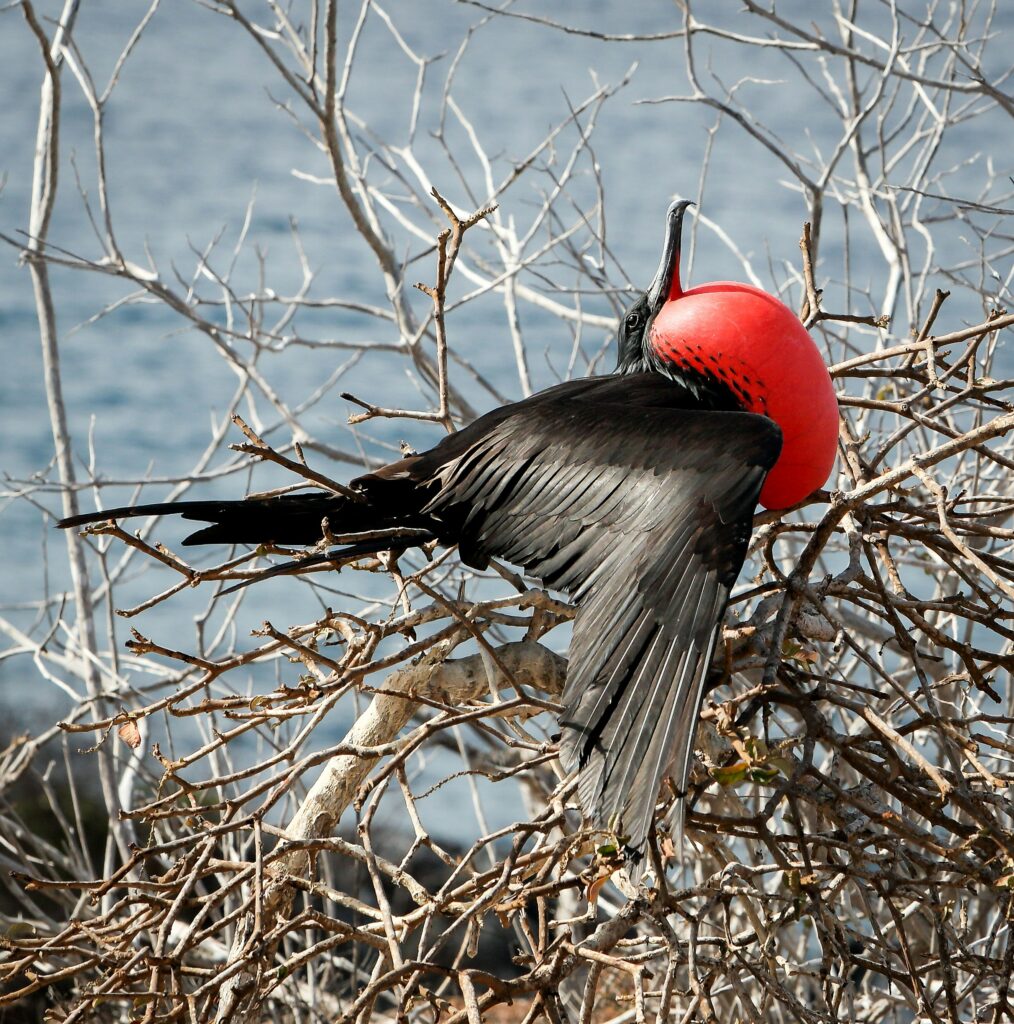
Yet for the Frigatebird, looking ridiculous to us is completely beside the point.
He has an audience to impress. While we humans may have dinner dates, flowers, and dating apps, male frigatebirds went with “enormous inflatable red throat.”
Honestly, I respect the commitment.
Life Beyond the Pirate Routine
For all the attention their aerial robberies get, Frigatebirds have a much fuller life than zooming around stealing fish. They breed in colonies, often gathering on islands. The five species include the magnificent, great, lesser, Ascension, and Christmas Island frigatebirds. Their life around breeding colonies is quite a contrast to the seemingly independent bird cruising over endless stretches of blue water. Eventually even a master of the sky has to come down.
Frigatebirds nest on land rather than trying to raise a family while permanently airborne, which seems sensible. Trying to keep an egg in a nest at 2,000 feet would be ambitious even for these birds.
Their ability to move between life on a nesting island and soaring over huge expanses of open ocean is part of what makes them so fascinating. They belong to the sea without really belonging on the sea.
They are creatures of that narrow world between ocean and sky. And what a world it is.
How It Finds Dinner
Being a pirate may get all the press, but the Frigatebird is perfectly capable of finding food without bothering its neighbors.
Frigatebirds feed on marine prey such as fish and squid, taking advantage of food available at or above the water’s surface. Flying fish are particularly well suited to a predator that specializes in catching food while remaining airborne.
Their hooked bills give them another useful tool for grabbing prey.
Then there is kleptoparasitism, which adds a completely different strategy. Rather than simply searching for a fish, a Frigatebird can watch what other animals are doing. One successful fishing bird can suddenly become a flashing neon sign advertising LUNCH. That strategy requires speed, maneuverability, timing, and a willingness to be the least popular bird at the party.
The Frigatebird appears to have all four covered.
The Perfect Frigatebird Heist
Picture it.
A booby has successfully plunged into the ocean and caught a fish. It takes off with its hard-earned meal. Above it, a dark shape turns.
The Frigatebird accelerates.
The booby tries to escape. The Frigatebird follows, using those long wings and forked tail to maneuver behind it. If the Frigatebird manages to grab a wingtip or tail, the other bird may eventually surrender its catch. The fish falls.
For a brief moment, nobody has it.
Then the Frigatebird dives after the prize and snatches it from the air.
No boat. No treasure map. No “Arrr!” Still definitely piracy.
More Than Just a Flying Thief
Calling the Frigatebird the pirate of the sky is fun, and honestly, the nickname fits beautifully. But focusing only on food stealing misses what is truly special about this bird. This is an animal extraordinarily adapted for life in the air.
Its lightweight build and massive wings make soaring a specialty. Its forked tail helps with aerial maneuvering. Its feeding strategies allow it to make a living from the ocean while avoiding the problems that would come from getting its plumage soaked. And its courtship display somehow manages to make an already unforgettable bird even stranger.
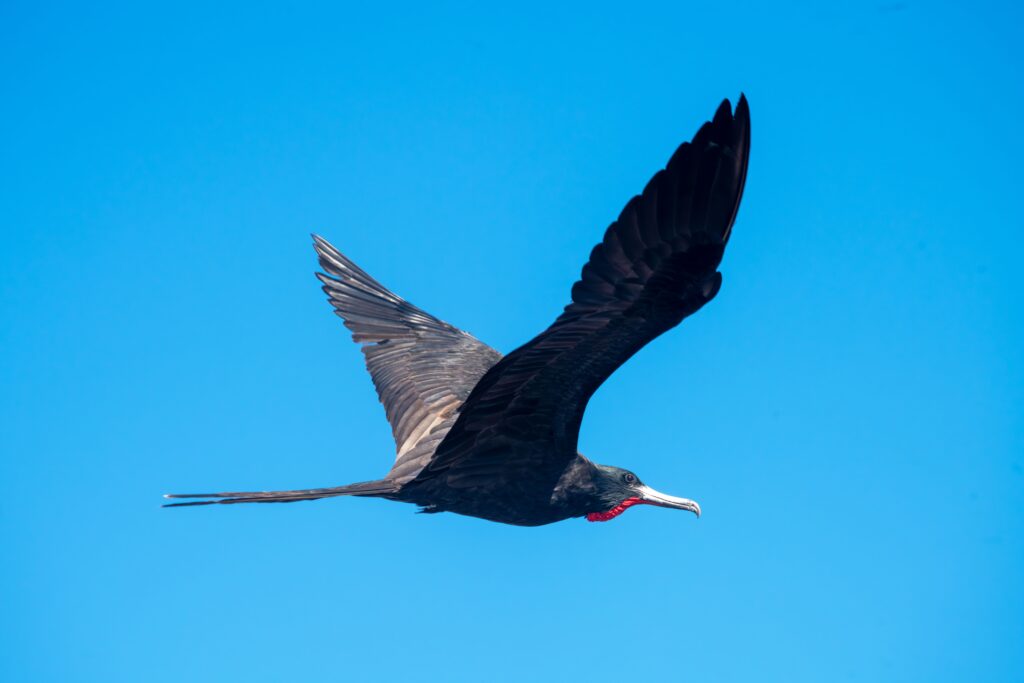
The stealing is really only one piece of a much bigger story.
A Frigatebird is an example of what happens when evolution pushes an animal toward one environment with incredible intensity. For these birds, that environment is the open sky. They do not have to be champion divers because they have become champion fliers.
They do not need to chase fish deep beneath the waves when they can find opportunities at the surface and in the air. And if some other bird happens to deliver lunch directly into their flight path?
Well. It would apparently be rude not to take advantage.
The Frigatebird Rules the Ocean Sky
There is something almost prehistoric about watching a Frigatebird soaring overhead.
Those giant angular wings stretch across the sky. The forked tail shifts and turns. The bird barely seems to move, yet somehow it keeps traveling, carried over an ocean that would be an enormous obstacle to most land animals. Then suddenly all that graceful soaring can turn into a high-speed chase. That contrast is what makes the Frigatebird so much fun.
One minute it is an elegant master of efficient flight. The next minute it is committing fish-related crimes. And somehow both sides of its personality make perfect sense.
The Frigatebird has found its niche above the tropical oceans and become exceptionally good at it. It can soar, hunt, maneuver, display, travel, and when opportunity knocks, steal somebody else’s seafood with breathtaking precision.
So the next time you see one gliding overhead, take a second to appreciate those magnificent wings. Admire that forked tail. Marvel at a bird designed for an extraordinary life in the air.
And if you happen to be holding a fish? Maybe keep an eye on it.
You have been warned.
Supporting Autumnelf on Ko‑Fi helps fuel new essays, book projects, ocean‑life explorations, theatrical deep dives, and the creative quests that make Phantom Orca Quest a vibrant, multimedia experience.
Get Me a Spark of Magic
