Some ocean creatures look like they belong in a nature documentary. Others look like they escaped from a fantasy novel, borrowed a wizard’s cloak, and decided to float across the sea casting tiny spells.
The Blue Dragon is firmly in the second category.
With its shimmering silver body and branching blue appendages that look like magical flames, the Blue Dragon seems almost too strange to be real. It drifts across the ocean surface like a living enchantment, dazzling anyone lucky enough to spot one. Yet beneath that beautiful appearance lies a creature that is surprisingly fierce, armed with stolen weapons and enough confidence to challenge animals many times its size.
If dragons existed in the ocean, they might look exactly like this.
Meet the Blue Dragon, Master of the Open Sea
The Blue Dragon, scientifically known as Glaucus atlanticus, is a species of sea slug. If you just pictured a typical garden slug crawling through a flower bed, I promise this little ocean wanderer is much more impressive than that.
Most sea slugs spend their lives creeping along the seafloor, blending into reefs or hunting among algae. The Blue Dragon took one look at that lifestyle and apparently decided it was far too ordinary.
Instead of living on the bottom of the ocean, the Blue Dragon floats at the surface. It drifts upside down, carried by currents and winds across vast stretches of open water. A small gas-filled sac inside its body helps keep it buoyant, allowing it to ride the waves like a tiny magical raft.
This unusual lifestyle places it in a community of surface-dwelling animals known as the neuston. These creatures live in the thin boundary between air and sea, creating a floating ecosystem that many people never even realize exists.
The Blue Dragon may only reach about an inch or two in length, but its appearance makes it seem much larger than life. Its body gleams silver on one side and blue on the other, creating a striking contrast that helps camouflage it from predators both above and below.
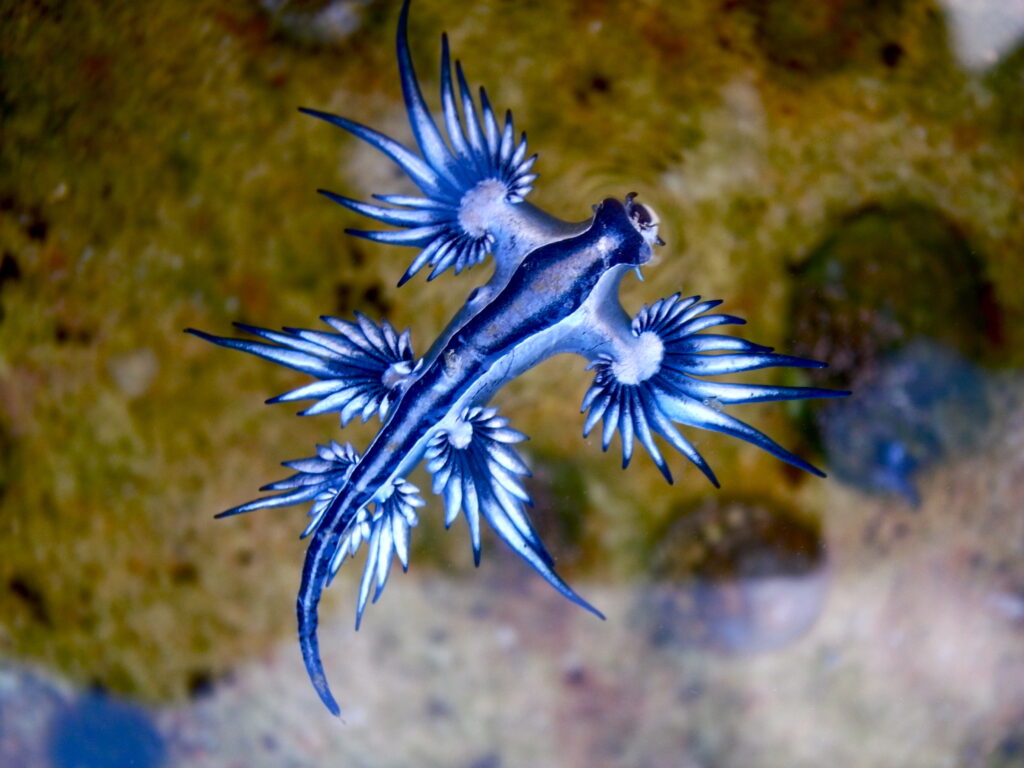
Sylke Rohrlach from Sydney, CC BY-SA 2.0, via Wikimedia Commons
Nature really said, “What if we made a sea slug look like an ice dragon?” and then followed through.
Why the Blue Dragon Looks Like Living Blue Fire
One glance at a Blue Dragon explains its name.
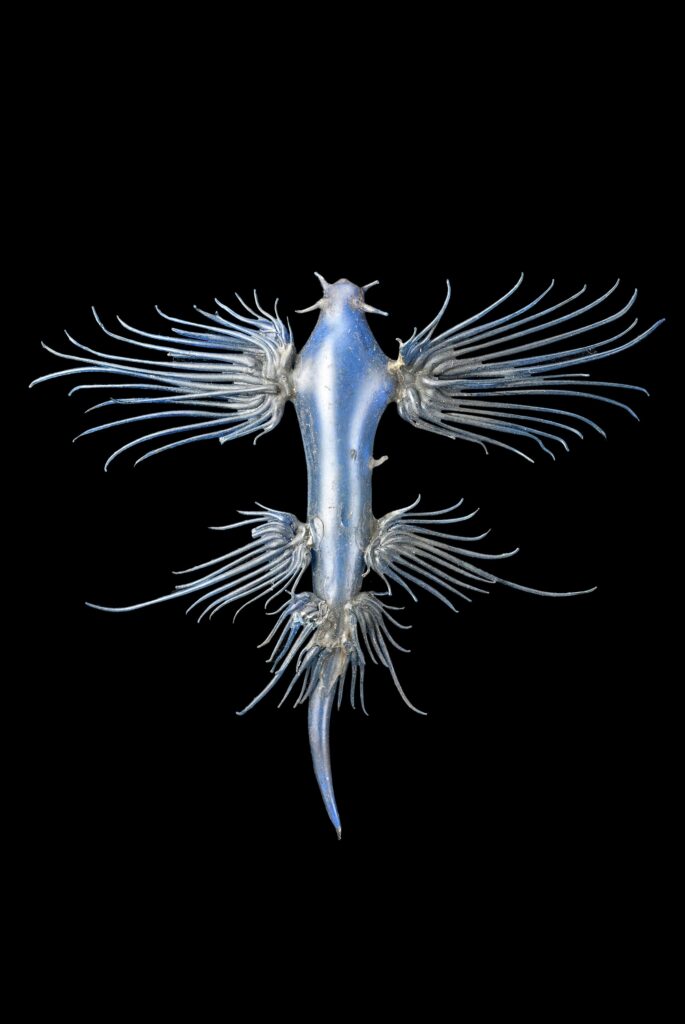
Extending from its body are branching structures called cerata. These elegant appendages spread outward like wings, flames, or magical antlers depending on your imagination. They create the illusion of a dragon soaring through the sea, even though the animal is mostly drifting wherever the currents decide to take it.
The blue coloration is not just beautiful. It serves an important purpose.
Countershading is a common camouflage strategy in marine animals. The Blue Dragon floats upside down, which means its coloring is reversed compared to many ocean creatures. Its blue side faces downward toward the water, helping it blend in when viewed from below. Its silvery side faces upward toward the sky, making it harder to spot from above.
It is essentially wearing a magical invisibility cloak. Well, as close to one as biology can manage. The result is a creature that can disappear remarkably well despite looking like it belongs on a fantasy book cover.
The Blue Dragon’s Most Surprising Trick
The Blue Dragon is beautiful. The Blue Dragon is adorable. The Blue Dragon is also carrying stolen weapons.
This is where things start getting wonderfully weird. Blue Dragons feed on venomous organisms that drift at the ocean’s surface. One of their favorite meals is the Portuguese man o’ war, a colonial animal famous for its painful sting.
Most animals see a Portuguese man o’ war and think, “Absolutely not.” The Blue Dragon sees one and thinks, “Lunch.”
As it consumes its prey, the Blue Dragon does something extraordinary. Instead of simply digesting the stinging cells, it stores them inside specialized sacs within its cerata. Those stolen stinging cells remain functional. In other words, the Blue Dragon takes biological weapons from its prey and repurposes them for its own defense.
Imagine being defeated by a dragon in a role-playing game only to discover it looted your equipment afterward and started using it better than you did. That is basically the Blue Dragon’s life strategy.
A Tiny Sorcerer Wrapped in Quiet Danger
The Blue Dragon’s appearance often inspires wonder, but it deserves a healthy amount of respect too.
Because it stores concentrated stinging cells from venomous prey, touching a Blue Dragon can result in a painful sting. In some cases, the sting may be even more intense than the original source because multiple stinging cells become concentrated within the creature’s defensive structures.
This makes the Blue Dragon an excellent example of why ocean wildlife should generally be admired from a distance. People sometimes assume that small animals are harmless. The Blue Dragon seems determined to prove otherwise.
Despite its delicate appearance and tiny size, it carries a powerful defense system that discourages predators and careless humans alike.
It is like finding out the cute little wizard in the corner of the fantasy tavern is secretly the highest-level character in the party.
Life Adrift Across the Ocean
Unlike many marine animals that establish territories or remain connected to reefs and coastlines, the Blue Dragon is largely at the mercy of currents. Ocean winds and surface flows transport these sea slugs across tropical and subtropical waters around the world. They can appear far from shore but sometimes wash onto beaches after storms or unusual current patterns.
Because they spend so much time drifting, Blue Dragons have adapted to a highly mobile lifestyle. Their world is constantly changing.
One day they may be floating alongside jellyfish relatives and other surface creatures. Another day they might be carried into an entirely different region of ocean.
There is something oddly poetic about that existence. The Blue Dragon has no need for roads, maps, or travel itineraries. It simply rides the ever-moving sea, trusting the currents to decide where the next chapter begins.
Honestly, some of us spend more time stressing over choosing a restaurant than the Blue Dragon spends planning its entire life.
The Strange Community Surrounding the Blue Dragon
The ocean surface can seem empty from above, but it hosts a surprisingly diverse collection of animals.
The Blue Dragon shares this floating world with creatures such as the Portuguese man o’ war, by-the-wind sailors, violet snails, and other unusual drifters adapted to life at the air-sea boundary.
This habitat is challenging. Surface organisms must deal with intense sunlight, wave action, changing weather, and predators approaching from multiple directions. Yet these creatures thrive in conditions that would be difficult for many other marine animals.
The Blue Dragon occupies a unique role within this surface community as both predator and prey. While it feeds on venomous drifters, it can also become food for larger animals capable of overcoming its defenses.
Every ocean habitat contains a web of connections, and the Blue Dragon is one fascinating thread within that network.
Why the Blue Dragon Captures Our Imagination
Some animals become famous because they are powerful. Others gain attention because they are enormous. The Blue Dragon succeeds by being spectacularly weird. And, as the geeky little weirdo, I am all for it.
It feels almost custom-designed to spark curiosity. It is tiny, brightly colored, slightly dangerous, and genuinely beautiful. It looks like a fantasy creature while somehow remaining completely real.
There is also a sense of contradiction woven into its story.
The Blue Dragon appears fragile but is remarkably resilient. It seems peaceful but carries stolen weapons. It drifts wherever the ocean takes it but survives in an environment full of challenges. These contradictions make it memorable in a way that many more familiar animals are not.
People often describe marine life as alien, and the Blue Dragon is a perfect example of why. It reminds us that evolution can produce forms every bit as strange and creative as anything found in mythology.
Sometimes reality is more imaginative than fiction.
Blue Dragon Encounters and Beach Discoveries
Finding a Blue Dragon is an unforgettable experience for beachcombers and ocean enthusiasts.
Because these creatures occasionally wash ashore, lucky observers may encounter them on sandy beaches after strong winds or ocean events. Their brilliant coloration often stands out against the sand, making them look like tiny jewels scattered along the shoreline.
The key word here is observe.
Photograph them. Admire them. Tell your friends you found a real-life ocean dragon. Maybe spend the rest of the day feeling unusually accomplished.
Just do not pick them up.
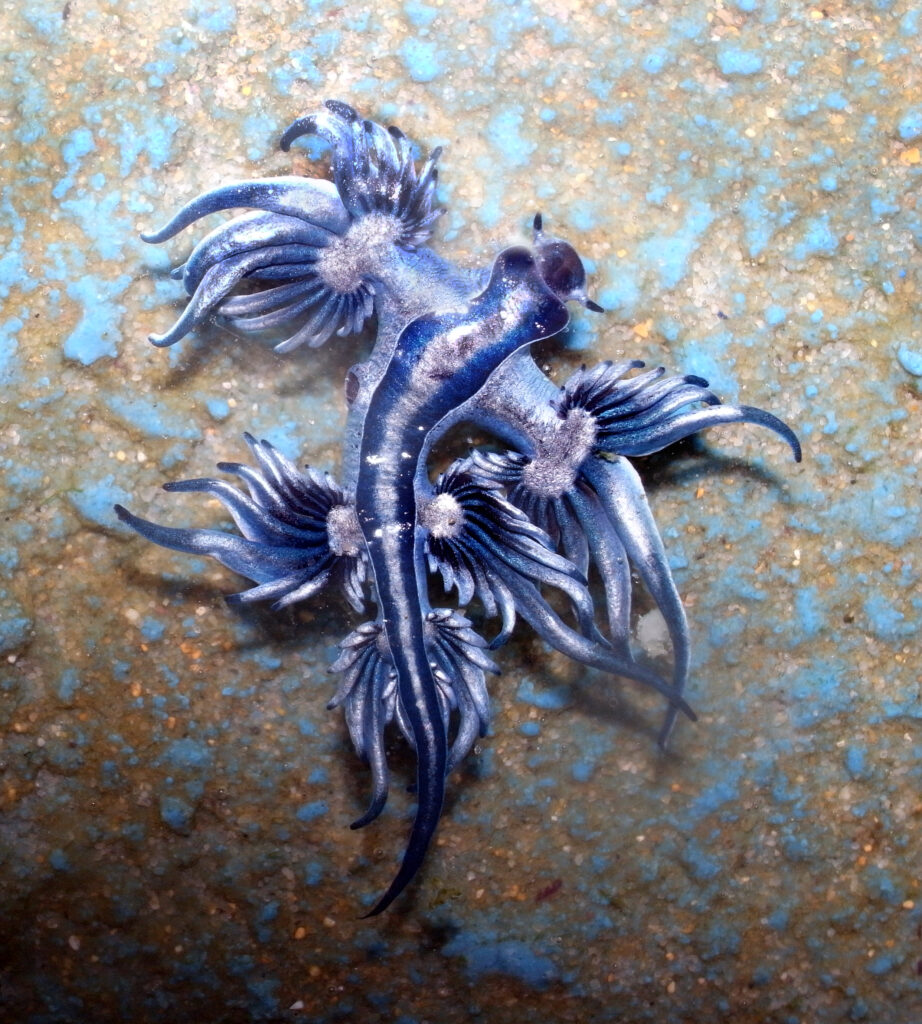
Their stinging defenses remain active even when they are stranded, and nobody wants to explain to their doctor that they got zapped by something that sounds like a fantasy mount from a role-playing game.
Respectful observation is the safest and best approach.
What the Blue Dragon Teaches Us About the Ocean
The ocean is filled with animals that challenge our expectations.
The Blue Dragon teaches an especially powerful lesson about assumptions. It reminds us that size does not determine importance, appearance does not reveal capability, and even the smallest creatures can occupy remarkable ecological roles.
At first glance, it looks like an ornament floating on the waves. A closer look reveals an active predator with specialized adaptations, sophisticated defenses, and a unique place within a complex ecosystem. That complexity exists throughout the ocean. Every tide pool, reef, seagrass meadow, and open-water habitat contains stories just as fascinating. The Blue Dragon simply happens to be one of the most visually dramatic storytellers in the sea.
The Enduring Magic of the Blue Dragon
It is easy to understand why the Blue Dragon has become a favorite among ocean lovers.
There is something enchanting about a creature that appears to wear blue fire, sails across the surface of the sea, and defends itself using borrowed stinging cells from its enemies. It sounds less like a sea slug and more like a magical character from an epic adventure. Yet the Blue Dragon needs no embellishment. Its real story is already extraordinary.
Floating between sea and sky, this tiny sorcerer drifts through the world’s oceans with quiet confidence. It carries beauty and danger in equal measure, proving that even the smallest marine creatures can leave a lasting impression.
The next time you imagine dragons, you might picture towering wings and mountains of treasure. I will be thinking about a one-inch sea slug riding the waves, wrapped in blue fire and armed with stolen magic.
Honestly, that dragon might be even cooler.
Supporting Autumnelf on Ko‑Fi helps fuel new essays, book projects, ocean‑life explorations, theatrical deep dives, and the creative quests that make Phantom Orca Quest a vibrant, multimedia experience.
Get Me a Spark of Magic
