When people first discover FNAF, they usually remember the jump scares. They remember Freddy appearing in the doorway, Foxy sprinting down the hallway, or the sudden realization that they forgot to check a camera thirty seconds ago and have made a terrible life choice. But the deeper you dive into the lore, the more you realize that the true heart of the franchise isn’t found in a security office or tucked away inside a malfunctioning animatronic. It’s hidden inside a rotting green rabbit known as Springtrap.
Few characters in gaming have undergone a transformation as horrifying or as fascinating as William Afton. Long before he became Springtrap, Afton was a businessman, engineer, and one of the key figures behind the rise of Fazbear Entertainment. He stood at the center of the company that would eventually become one of the most infamous fictional businesses in gaming history. Yet over time, his actions set off a chain reaction of tragedies that would haunt generations of characters and define nearly every major event in the FNAF timeline. That chain reaction ultimately led to the creation of Springtrap.
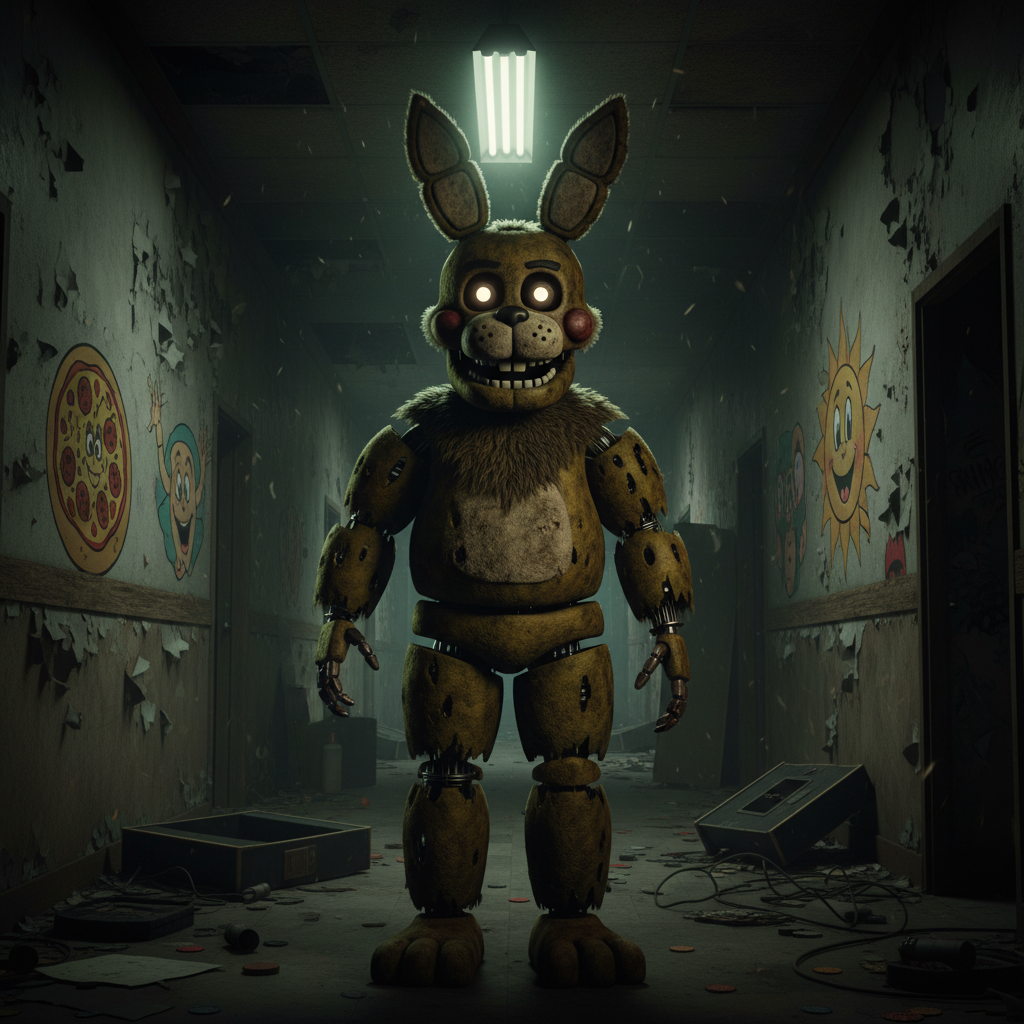
What makes Springtrap so compelling is that he isn’t simply a villain. Horror games are full of villains. They’re lurking in haunted mansions, stalking players through abandoned hospitals, and popping out of ventilation shafts with alarming enthusiasm. Springtrap stands apart because he represents something much bigger than a standard monster encounter. He is the living embodiment of consequence. Every torn piece of fabric, every exposed wire, and every damaged component tells the story of a man who spent years creating pain, only to become trapped inside the physical manifestation of his own actions.
In many ways, Springtrap is where all the major themes of FNAF collide. He’s horror and mystery. He’s tragedy and punishment. He’s the past refusing to stay buried. While Freddy Fazbear may be the franchise mascot, Springtrap is arguably the character who best represents the overall narrative. Remove him from the story, and massive sections of the lore simply stop working. The Missing Children Incident changes. William Afton’s story disappears. Entire character arcs lose their emotional weight.For lore enthusiasts, that’s part of what makes Springtrap so endlessly fascinating. He’s not merely connected to the story. He is the story.Over the years, fans have spent countless hours analyzing his origins, debating timeline details, dissecting gameplay mechanics, and exploring the symbolism hidden beneath his decaying exterior. Entire YouTube channels, theories, and community discussions have been built around trying to understand who Springtrap is and what his existence means for the larger world of FNAF.
And the remarkable thing is that after all these years, we’re still talking about him.
Not because he’s the loudest character in the franchise. Not because he’s the flashiest.
But because no other character carries the same narrative weight.
Springtrap isn’t just another animatronic lurking in the dark. He’s the ghost of everything that went wrong in FNAF, and no matter how many years pass, he never truly goes away.
Before Springtrap: The Rise and Fall of William Afton
Before there was Springtrap, there was William Afton.If you’re looking for a comprehensive deep dive into Afton’s full history, motivations, family connections, and evolution throughout the series, I highly recommend checking out my dedicated article, The Rise and Fall of a Villain: FNAF’s William Afton. That piece explores the man himself in far greater detail. For our purposes here, however, we’re focusing on the parts of William Afton’s story that eventually lead to the creation of Springtrap.
Because as fascinating as Springtrap is, he didn’t emerge from nowhere. He’s the final result of decades of choices, mistakes, obsessions, and horrors that began with one man.
One of the most interesting aspects of FNAF lore is that William Afton wasn’t introduced as an obvious supervillain. Fans didn’t meet him through dramatic speeches or elaborate cutscenes. Instead, he emerged gradually through clues, mini-games, and scattered pieces of evidence hidden throughout the franchise. Long before players knew his name, they knew something was wrong. There was a mysterious figure lurking in the background of countless tragedies, and every time fans followed the breadcrumbs, they seemed to lead back to the same person.
Eventually that person became known as William Afton.
On the surface, Afton should have been one of the success stories of the Fazbear Entertainment universe. Alongside Henry Emily, he helped build the foundations of a business that would become beloved by children for generations. He was an engineer, an inventor, and a businessman with a talent for creating animatronic technology that felt years ahead of its time.Unfortunately, being brilliant and being wise aren’t always the same thing.
One of the recurring themes throughout FNAF is that intelligence alone doesn’t make someone a good person. Afton serves as perhaps the franchise’s greatest example of that lesson. The same mind capable of designing advanced robotic systems was also capable of causing unimaginable harm. As players learned more about the timeline, a disturbing pattern emerged. Missing children, haunted animatronics, family tragedies, and restaurant closures seemed connected by an invisible thread.
Eventually, that thread always led back to Afton.
What makes William such an effective antagonist is that his evil isn’t wrapped in supernatural powers or world-ending schemes. He’s terrifying because he’s human. The horrors that unfold throughout the timeline begin with decisions. Choices. Actions. Every major tragedy can be traced back to moments where Afton deliberately chose a darker path.
Yet even before discussing his crimes, it’s important to understand something about his character. William Afton is obsessed with control. He wants to understand how things work. He wants to manipulate outcomes. He wants to stay one step ahead.
Again and again throughout the lore, Afton attempts to bend circumstances to his advantage. He hides behind masks. He conceals his intentions. He uses technology as both a shield and a weapon. While other characters react to events around them, Afton constantly tries to shape those events himself.
For years, it works. That’s part of what makes his eventual transformation into Springtrap so compelling.
When we first encounter William in the timeline, he’s often the one moving pieces around the board. He’s the person creating problems for everyone else. He’s the architect of suffering rather than its victim. The world seems to operate according to his plans, even when those plans create devastation for others.Springtrap completely reverses that dynamic.
The irony at the heart of Springtrap’s story is that William Afton spends much of his life hiding behind the Spring Bonnie suit. The costume becomes a symbol of anonymity, protection, and deception. It allows him to move unnoticed. It allows him to conceal who he really is. In many ways, the suit becomes an extension of his identity.
But the deeper meaning of Springtrap only becomes clear when you examine that relationship.
The thing William uses to hide eventually becomes the thing that traps him. The costume he once controlled becomes his prison. The technology he trusted becomes his executioner. The rabbit suit that helped define his darkest actions ultimately defines his punishment as well.
This isn’t just effective horror storytelling. It’s some of the strongest symbolism in the entire FNAF franchise.
When fans think about Springtrap, it’s easy to focus on the rotting exterior, the exposed wires, or the grotesque imagery. Those visual elements are certainly memorable. But none of them would carry the same impact without understanding William Afton first. Springtrap isn’t frightening solely because he looks disturbing. He’s frightening because every ripped seam and broken component represents the downfall of a man who believed he could always stay in control.In the end, that’s what makes Springtrap such a powerful character. He’s not simply a monster lurking in the dark. He’s William Afton’s entire story collapsing inward around him.And before the rabbit suit became a tomb, before the springlocks failed, and before Fazbear’s darkest legend was born, there was simply a man who thought he could outrun the consequences of his own actions.
As we’re about to see, he couldn’t.
The Spring Bonnie Suit and the Dangerous Legacy of Springlocks
Before Springtrap became one of the most infamous figures in FNAF lore, he was simply Spring Bonnie.Well, “simply” might be doing a lot of heavy lifting there.Even before William Afton became trapped inside the suit, Spring Bonnie occupied a unique place in Fazbear history. Alongside Fredbear, Spring Bonnie was one of the original mascots of Fredbear’s Family Diner, the small restaurant that would eventually serve as the foundation for the sprawling and deeply cursed Fazbear universe. To children visiting the diner, Spring Bonnie was meant to be friendly, welcoming, and entertaining. To modern lore fans, however, the character is better known as the rabbit suit that would become one of the most important objects in the entire franchise.
The reason Spring Bonnie matters so much is because of what was hidden beneath the costume.
Unlike the standard animatronics that would later appear throughout various Freddy Fazbear locations, Spring Bonnie was a springlock suit. This special type of animatronic was designed with an ambitious and, in hindsight, catastrophically bad idea in mind. The suits were intended to function in two different ways. They could operate as traditional animatronics for performances, but they could also be worn by human employees as costumes.
At first glance, that probably sounded incredibly innovative. In practice, it was essentially a lawsuit with ears.The challenge facing the engineers was figuring out how a machine filled with motors, endoskeleton parts, and moving components could also hold a person. Their solution was a system known as springlocks. When activated, these mechanisms pulled dangerous internal components away from the center of the suit and held them in place, creating enough room for an employee to climb inside.
As long as everything worked perfectly, the system functioned exactly as intended.
The problem was that everything rarely works perfectly.
The springlocks were notoriously sensitive. Sudden movements, moisture, vibrations, improper maintenance, or mechanical failures could all cause the locks to release unexpectedly. If that happened, every compressed metal component inside the suit would snap back into its original position.
Unfortunately for anyone wearing the costume at the time, their body would be occupying that exact space.
It’s one of those fictional concepts that somehow becomes more terrifying the longer you think about it.What’s particularly fascinating is that the danger of springlock suits wasn’t a secret. Throughout the lore, we learn that Fazbear Entertainment was aware of the risks. Employees received training regarding proper procedures. Safety recommendations existed. There were warnings about moisture and movement. There were protocols designed to prevent accidents.Yet the suits continued to be used.
That detail says quite a bit about both Fazbear Entertainment and the culture surrounding the early years of the company. Time and time again throughout FNAF, we see examples of convenience and spectacle being placed ahead of safety. The springlock suits may be one of the earliest and most obvious examples of that pattern.For William Afton, however, the Spring Bonnie suit eventually became more than just a costume. It became a disguise.
Over time, the yellow rabbit became closely associated with some of the darkest events in franchise history. Afton used the suit to hide his identity, creating one of the most important and disturbing connections in the timeline. The costume that children saw as friendly and familiar became a mask behind which terrible actions could be concealed.
That symbolism becomes incredibly important later.
Spring Bonnie represents deception. The suit allows Afton to become someone else. It provides anonymity, protection, and distance from his actions. Whenever William puts on the rabbit costume, he’s effectively creating a barrier between who he is and what he’s doing.
For years, that barrier works. The rabbit suit becomes an extension of his control. His mask. His hiding place. His greatest tool.
Which is precisely why the eventual springlock failure is so poetic.
The same suit that helped him hide from consequences ultimately becomes the source of those consequences. The costume he trusted betrays him. The machine he relied upon destroys him. The rabbit persona he used to separate himself from responsibility becomes the prison that traps him forever.
In many ways, this is why the Spring Bonnie suit remains one of the most important objects in all of FNAF lore. It’s not simply where Springtrap comes from. It’s the physical representation of William Afton’s rise and fall.Without Spring Bonnie, there is no Springtrap. Without the springlock suits, there is no defining moment of William Afton’s story.
The rabbit suit wasn’t just another costume hanging backstage. It was the fuse waiting to ignite one of the biggest tragedies in FNAF history.
The Fall of William Afton: How Springtrap Was Born
Every great horror villain has an origin story.
For some, it’s a tragic accident. For others, it’s an act of revenge, a curse, or a supernatural transformation. Springtrap’s creation is something much rarer in horror storytelling. It’s a perfect example of poetic justice.
The fall of William Afton isn’t simply the moment he dies. It’s the moment all the choices he made throughout his life finally catch up to him.
And perhaps the most fascinating part of the story is that the thing that destroys him isn’t a hero.It isn’t the police. It isn’t Henry Emily. It isn’t even one of the animatronics. It’s his own creation.To understand why that matters, we first have to look at the final days leading up to Afton’s transformation into Springtrap.
By this point in the timeline, multiple tragedies had already occurred. The Missing Children Incident had left a permanent stain on Fazbear Entertainment’s history. Restaurants had closed. Rumors spread. The company repeatedly attempted to move forward while distancing itself from past scandals.But the past has a funny way of refusing to stay buried.
One of the most important sequences in the lore appears in the “Follow Me” mini-games. These events show William Afton returning to an abandoned Freddy Fazbear’s Pizza long after its glory days have ended. The building is deteriorating. The atmosphere is unsettling. Everything feels forgotten. Except Afton.For reasons that are still heavily discussed within the fandom, William begins dismantling the animatronics one by one.
Freddy.
Bonnie.
Chica.
Foxy.
The characters that once entertained children are systematically torn apart.
On a surface level, this might seem like another example of Afton trying to cover his tracks. However, many theories suggest he’s searching for something deeper. Throughout later installments, concepts such as remnant and soul possession become increasingly important to understanding the franchise’s supernatural elements. Some fans believe Afton was attempting to understand the strange forces connected to the haunted animatronics.
The exact details remain a topic of debate. What isn’t debated is what happens next.
As the mini-games progress, Afton succeeds in dismantling the animatronics.
Then everything changes. The spirits connected to those animatronics appear. Suddenly, for the first time in the timeline, the man who spent years creating fear becomes the one experiencing it. It’s a remarkable reversal.Throughout most of the story, William Afton operates from a position of control. He’s always the one making plans, manipulating situations, and staying several steps ahead of everyone else. He hides behind masks. He exploits technology. He uses secrecy as a weapon.
Now none of those advantages matter.
The ghosts don’t care about his plans. They don’t care about his excuses. They don’t care how clever he is. They’ve come for him.
What makes this scene so powerful is the sense of inevitability surrounding it. The audience understands something Afton still refuses to accept. His luck has finally run out.
Cornered and desperate, William retreats to the one thing that has protected him countless times before. The Spring Bonnie suit. It’s such a small decision, but it’s arguably the most important decision he ever makes.
The suit has always been his shield. It’s how he hid in plain sight. It’s how he concealed his identity. The rabbit costume became a symbol of control, allowing him to separate himself from his actions. Whenever he wore it, he could pretend there was distance between who he really was and what he was doing.
In Afton’s mind, stepping into the suit must have felt familiar. Safe. Predictable. A return to the one thing that had always worked. The tragedy is that the audience already knows better. The Spring Bonnie suit has never truly been safe.
The franchise spends considerable time establishing the dangers of springlock technology. Moisture, movement, and mechanical malfunction could cause catastrophic failures. Employees were warned. Procedures existed. Entire protocols were built around minimizing the risk.
Unfortunately for William Afton, panic isn’t exactly known for producing calm, careful adherence to safety procedures.
As rain leaks into the building and moisture affects the suit’s mechanisms, the springlocks fail.
Then comes one of the most infamous moments in all of FNAF lore.
Metal components snap inward. Mechanical systems collapse. The suit that once protected him becomes a death trap. The rabbit costume closes around him like a steel coffin.
What happens next is horrifying enough that the games wisely leave much of it to the player’s imagination. And honestly, imagination often does the job better than explicit details ever could. It’s kind of like the movies that way﹘ you don’t need to see it happen to know that it did. We don’t need a graphic depiction to understand the horror. The realization alone is terrifying.
Every mechanism designed to make the suit function is suddenly working against its wearer. Every component becomes part of the execution. Every piece of technology Afton once trusted betrays him.From a storytelling perspective, this is brilliant.T
hematically, Springtrap’s creation isn’t random. It’s not bad luck. It’s not an accident in the traditional sense. It’s consequence.
Throughout the franchise, William Afton repeatedly uses costumes, machinery, and technology to gain power over others. He trusts his intelligence. He trusts his inventions. He trusts his ability to manipulate situations. His downfall comes from that same source.
The machine he created destroys him. The disguise he relied upon imprisons him. The rabbit persona he used for years becomes his tomb. It’s one of the strongest examples of poetic justice in modern horror gaming.
Yet somehow, this isn’t the end. And that’s where Springtrap’s story becomes truly disturbing.
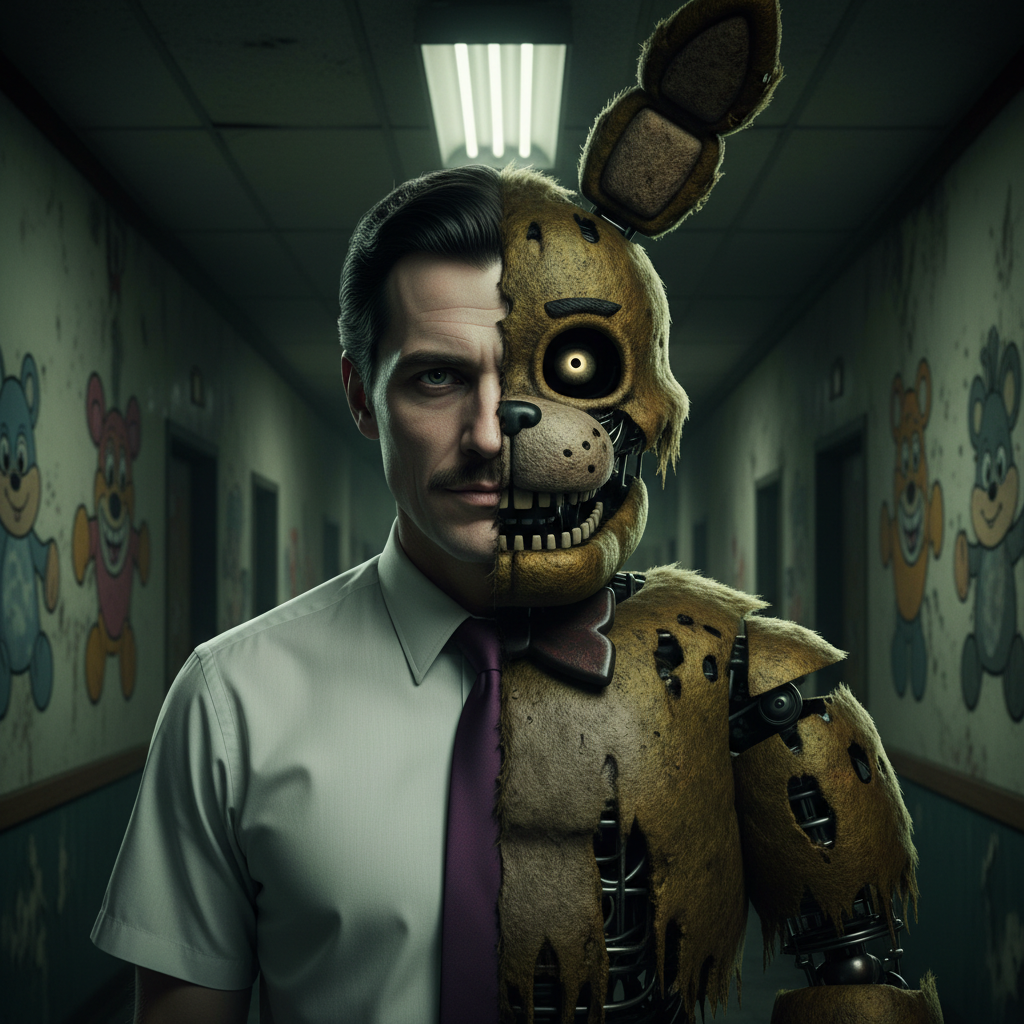
In most horror stories, death provides closure. The villain dies and the narrative moves forward. Even if tragedies remain unresolved, death creates a stopping point.
William Afton doesn’t get that luxury. Instead of moving on, he’s trapped. His body remains within the suit. Years pass. Then decades. The abandoned safe room becomes his prison. Dust gathers. Restaurants close. Entire generations of Fazbear history come and go.
Still, Springtrap remains.
This is where the horror shifts from physical suffering to something much more existential.
Imagine being trapped inside a decaying suit for years. Then imagine decades passing while the world moves on without you. Buildings age. Companies collapse.
Your story becomes rumor and urban legend. Meanwhile, you’re still there. Still trapped. Still imprisoned inside the very thing that destroyed you.
For many fans, this is what elevates Springtrap from a standard horror villain to one of the most fascinating characters in the franchise. His transformation isn’t merely a gruesome death scene. It’s a permanent state of punishment.
The rabbit suit becomes more than a costume. It becomes a prison sentence. Every torn seam, every exposed wire, and every damaged section of the suit serves as a reminder of the moment William Afton lost control forever. Or at least, as much as someone like William Afton ever can.
Because if FNAF teaches us anything, it’s that death may have finally caught up to William Afton. Keeping him gone is an entirely different challenge.
Springtrap in FNAF 3: The Gameplay That Changed Everything
By the time players encountered Springtrap in Five Nights at Freddy’s 3, the franchise had already established several familiar gameplay traditions. Multiple animatronics roamed the building. Players needed to track their movements. Every character had unique mechanics, unique attack patterns, and unique ways of sending players into an immediate state of regret.
Then FNAF 3 arrived and changed the formula entirely.
Instead of facing a collection of active threats, players were suddenly forced to survive against a single real enemy.Springtrap.At first, that might sound less intimidating. After all, dealing with one killer animatronic should theoretically be easier than juggling Freddy, Bonnie, Chica, Foxy, and whatever fresh nightmare happened to be lurking around the corner.
The reality was exactly the opposite.
By focusing almost entirely on Springtrap, FNAF 3 transformed him from another animatronic into a relentless predator. Rather than dividing the player’s attention among several different enemies, the game forces players to focus on one horrifying truth:
Springtrap is always somewhere nearby. And he’s coming closer.
What makes this gameplay approach so brilliant is how perfectly it matches the lore.
Previous animatronics often felt reactive. They wandered the restaurant. They followed certain patterns. While dangerous, they sometimes felt like haunted machines carrying out predetermined behaviors.
Springtrap feels different from the moment players encounter him. He feels intentional. He feels intelligent. Most importantly, he feels like he’s hunting you.
That distinction is crucial because the character isn’t merely another ghost inhabiting a robot. This is William Afton. The same master manipulator who spent decades staying ahead of consequences. The same individual responsible for some of the darkest events in the timeline.
His gameplay reflects that intelligence.
Throughout FNAF 3, Springtrap moves through the attraction using both hallways and ventilation shafts. Players can track his location through a network of security cameras spread throughout Fazbear’s Fright. Unlike previous games where cameras served primarily as warning systems, the cameras in FNAF 3 become essential tools in an ongoing battle of strategy and prediction.
Every camera check becomes a question.
Where is Springtrap now? Where is he heading next? How much time do I have before things go catastrophically wrong?And because this is FNAF, the answer is usually “less time than you’d like.”One of the most unique mechanics in the game is the audio lure system. Players can trigger sounds throughout the attraction to attract Springtrap toward specific rooms. This transforms gameplay from passive observation into active manipulation.
Rather than simply reacting to danger, players attempt to control it.
The relationship between player and Springtrap becomes almost chess-like. Every sound broadcast is a calculated move designed to redirect him away from the office. Every camera check is part of a larger strategy.
Of course, Springtrap doesn’t always cooperate. Because that would be far too easy.
The audio mechanic is particularly interesting from a lore perspective because it reinforces the idea that William Afton retains awareness and intelligence. Springtrap isn’t blindly following programming. He responds to sounds with a level of curiosity and purpose that makes him feel remarkably human compared to previous threats.
That’s what elevates him above many other animatronics. He’s making decisions. He’s investigating. He’s adapting. The game never explicitly says these things, but players instinctively feel them.
As a result, Springtrap becomes one of the most psychologically intimidating opponents in the franchise.
Adding to the tension are the ventilation systems that run throughout Fazbear’s Fright. While cameras might be the first thing players think about when discussing FNAF 3, the ventilation mechanics are arguably just as important.
When ventilation failures occur, players begin experiencing visual and auditory distortions. The screen becomes unstable. Hallucinations intensify. Monitoring Springtrap becomes significantly more difficult.
This creates a brilliant gameplay loop.
Every second spent repairing systems is a second not tracking Springtrap. Every second spent monitoring Springtrap is a second allowing something else to break. The game constantly forces players to choose between competing priorities. And that’s before we even discuss the Phantom Animatronics.
One of the cleverest features of FNAF 3 is that many of the frightening figures players encounter are not technically real threats. Phantom Freddy, Phantom Foxy, Phantom Chica, and the others exist primarily to create distractions and system failures.
These characters are startling, unsettling, and deeply annoying in exactly the way they’re supposed to be. Yet none of them can actually end your night. Only Springtrap can.
That’s a fascinating design choice.
The previous games conditioned players to fear multiple attackers. FNAF 3 weaponizes that expectation. The Phantoms fill the attraction with chaos and panic while Springtrap quietly continues his approach. He’s the real danger hidden behind all the noise.
Which, if you think about it, is a pretty accurate summary of William Afton’s role throughout the lore as well.
For many fans, this is what makes FNAF 3 such an important chapter in the franchise. The gameplay isn’t just mechanically different from earlier titles. It serves the narrative.
Everything revolves around Springtrap.
The cameras. The audio. The ventilation. The hallucinations.
The entire experience is built around surviving an encounter with William Afton after his transformation.Few antagonists in the series are given that level of focus. Even fewer have their gameplay designed so closely around their personality and lore.
Springtrap isn’t scary in FNAF 3 simply because he can jumpscare the player. He’s scary because the game makes him feel patient. Methodical. Persistent. Like someone who has spent decades trapped in darkness and suddenly found a new opportunity to continue moving forward.
In many ways, FNAF 3 succeeds because it translates Springtrap’s lore directly into gameplay. The player experiences the same thing the story describes. No matter how carefully you plan, no matter how many systems you monitor, and no matter how many times you think you’ve redirected him somewhere else, Springtrap keeps coming.
Relentlessly. Inescapably. Like the consequences William Afton spent his entire life trying to avoid.
Timeline Connections Across the Franchise
One of the reasons Springtrap remains such an important figure in FNAF lore is that his story doesn’t exist in isolation. Unlike many horror villains who appear in a single game before fading into the background, Springtrap is woven directly into the timeline of the franchise. In many ways, he serves as a bridge connecting the earliest events of the story to many of its later developments.
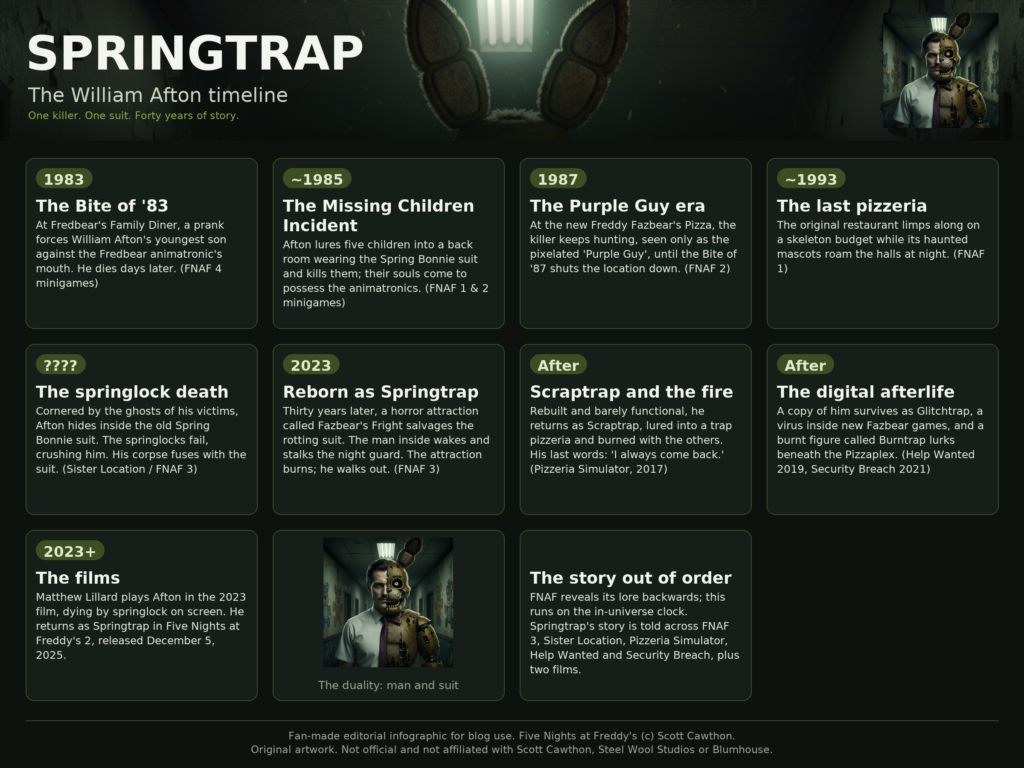
His connections begin with Fredbear’s Family Diner, where the Spring Bonnie suit first appears alongside Fredbear. What initially seems like a relatively simple piece of animatronic technology eventually becomes one of the most significant objects in the entire franchise. The suit’s existence ties Springtrap directly to the earliest known chapter of Fazbear history, making him one of the few characters whose story stretches across nearly the entire timeline.
Springtrap is also inseparable from the Missing Children Incident. Long before the character ever appeared on screen, William Afton’s actions helped shape the supernatural foundation of the series. The spirits inhabiting many of the animatronics, the haunted restaurants, and the cycle of tragedy that follows Fazbear Entertainment throughout its existence can all be traced back to events connected to Afton. When he later becomes Springtrap, the character effectively becomes a physical embodiment of the franchise’s unresolved past.
His story is equally connected to Henry Emily. While Afton spent much of the timeline causing harm, Henry ultimately becomes one of the individuals most determined to stop him. Their rivalry extends across decades and reaches its emotional climax in Freddy Fazbear’s Pizzeria Simulator. Without Springtrap, Henry’s final plan loses much of its narrative significance because the central source of so much suffering would be absent.
Springtrap’s relationship with Michael Afton adds another layer of depth. Depending on your interpretation of certain timeline details, much of Michael’s journey can be viewed as an attempt to clean up the damage created by his father. This transforms the story from a simple battle between good and evil into a tragic family conflict spanning multiple games. Every appearance by Springtrap carries emotional weight because he represents not only a monster but also a father whose actions devastated those closest to him.
Even later entries in the franchise continue to feel Springtrap’s influence. Whether examining Scraptrap, discussing remnant, exploring Glitchtrap theories, or debating Burntrap’s role in newer games, fans inevitably find themselves returning to William Afton’s original transformation. The details may evolve, but the central idea remains remarkably consistent: the consequences of Afton’s actions continue to echo throughout the timeline.
That’s what makes Springtrap so unique within FNAF lore. He isn’t merely connected to one important event. He’s connected to almost all of them. His story touches the origins of Fazbear Entertainment, the franchise’s central tragedies, its major protagonists, and many of its most enduring mysteries.
Few characters in gaming can claim that kind of narrative reach, and that’s exactly why Springtrap remains one of the most important figures in the entire FNAF universe.
The Symbolism of Springtrap
Beyond the lore, jump scares, and endless fan theories, Springtrap serves a much larger purpose within FNAF. He isn’t just a villain. He’s a symbol of consequence.
Throughout the franchise, William Afton spends years avoiding responsibility for his actions. He hides behind costumes, manipulates situations, and repeatedly escapes the fallout of the tragedies he creates. For a long time, it seems as though he can outrun any consequence simply by staying one step ahead of everyone else.
Then he becomes Springtrap.
What makes this transformation so powerful is that Afton’s punishment comes directly from the tool he once relied upon. The Spring Bonnie suit acted as a disguise, allowing him to conceal his identity and separate himself from his actions. When the springlocks fail, that same suit becomes his prison. The mask he used to hide who he was literally fuses itself to him.In that sense, Springtrap represents karma in its most horrifying form.
He also symbolizes the idea that the past never truly stays buried. One of the recurring themes throughout FNAF is the inability to escape history. Restaurants close, buildings are abandoned, and Fazbear Entertainment repeatedly attempts to move forward, but the consequences of previous events always return. Springtrap embodies that theme perfectly. Decades after William Afton’s death, he remains trapped within the suit, waiting to be rediscovered.
His design reinforces this symbolism. Everything about Springtrap is decayed. The suit is deteriorating. The endoskeleton is exposed. Time has left visible scars on every part of him. Yet despite appearing broken, he continues moving forward. The character becomes a visual reminder that some wounds never fully heal and some mistakes continue affecting the future long after they are made.
Perhaps most importantly, Springtrap represents the failure of control. William Afton spends most of the timeline trying to manipulate events and stay in charge of every situation. By becoming Springtrap, he loses that control completely. The inventor becomes trapped inside his own invention. The architect of so much suffering becomes imprisoned by the very technology he trusted most.
That is why Springtrap remains one of the most compelling characters in FNAF. He’s not merely a monster hiding in the dark. He’s a walking reminder that actions have consequences, secrets eventually surface, and the past often returns when we least expect it.And in the world of FNAF, those consequences happen to wear a rotting rabbit suit.
Legacy and Final Thoughts
Few characters in gaming have left a mark on their franchise quite like Springtrap.Years after his first appearance in FNAF, the character remains one of the most discussed, analyzed, and debated figures in the series. New animatronics have been introduced. New mysteries have emerged. Entirely new generations of players have entered the fandom. Yet somehow, conversations about FNAF lore almost always find their way back to Springtrap.
Part of that staying power comes from his design. The image of a decaying green rabbit with exposed wires and a corpse trapped inside is difficult to forget. But visual horror alone doesn’t explain why Springtrap continues to dominate lore discussions more than a decade after his debut.
The real reason is much simpler.
Springtrap matters.
His story sits at the crossroads of nearly every major event in the franchise. Through Springtrap, fans can explore William Afton’s rise and fall, the history of Fazbear Entertainment, the Missing Children Incident, the haunted animatronics, Michael Afton’s journey, Henry Emily’s final plan, and countless theories that continue to shape community discussions today.
In many ways, Springtrap is where the larger narrative of FNAF truly comes together.
He’s not just a villain. He’s a timeline. He’s a mystery. He’s a cautionary tale about what happens when someone spends their life trying to outrun the consequences of their actions.
What makes Springtrap particularly memorable is that his story never feels entirely finished. Every new piece of lore seems to create another question. Every answer opens the door to another theory. Even now, fans continue debating his role, his motivations, and the lasting impact of his actions on the franchise’s timeline.
That enduring fascination is the mark of a truly successful character.
At the end of the day, Springtrap isn’t just another animatronic lurking in the shadows. He’s the embodiment of everything that makes FNAF such a compelling franchise: mystery, tragedy, horror, symbolism, and a story that rewards those willing to dig a little deeper.
And for a character who spent decades trapped in a forgotten room, that’s a pretty impressive legacy.
Supporting Autumnelf on Ko‑Fi helps fuel new essays, book projects, ocean‑life explorations, theatrical deep dives, and the creative quests that make Phantom Orca Quest a vibrant, multimedia experience.
Get Me a Spark of Magic
