Imagine being a scientist in the early 1900s and confidently telling the world that a particular animal, the coelacanth, had been extinct for roughly 66 million years. The fossil record seemed clear. The evidence looked solid. The case appeared closed. Then imagine that animal casually showing up in a fishing net and ruining everyone’s certainty in a single afternoon.
That is exactly what happened with it. It was a fish so astonishing that its rediscovery became one of the greatest zoological surprises in modern history. If the natural world had a category for “things that should not be here anymore but somehow are,” this incredible creature would be the poster child.
The story of the Coelacanth is not just about a strange fish lurking in the ocean depths. It is about scientific assumptions, evolutionary history, and the humbling reminder that nature still has plenty of secrets tucked away in dark corners of the planet. It is a tale involving ancient oceans, mysterious underwater caves, and a creature that has survived mass extinctions, shifting continents, and enough geological drama to make most species throw in the towel.
And somehow, despite everything Earth has thrown at it, the Coelacanth is still swimming. Not bad for a fish that spent millions of years convincing everyone it was dead.
A Creature Born in Deep Time
To understand why the Coelacanth fascinates scientists and nature enthusiasts alike, we have to travel far back into Earth’s history.
We’re not talking thousands of years. We’re not talking hundreds of thousands of years. We are talking hundreds of millions.
The ancestors of the Coelacanth first appeared during the Devonian Period, roughly 400 million years ago. For perspective, trees were relatively new, dinosaurs had not yet appeared, and the first vertebrates were only beginning to explore life beyond the water.
The ancient world looked dramatically different from the one we know today. Continents were arranged in unfamiliar configurations. Entire ecosystems existed that have no modern equivalent. Through all of that, early coelacanth relatives swam through prehistoric seas alongside creatures now known only through fossils.
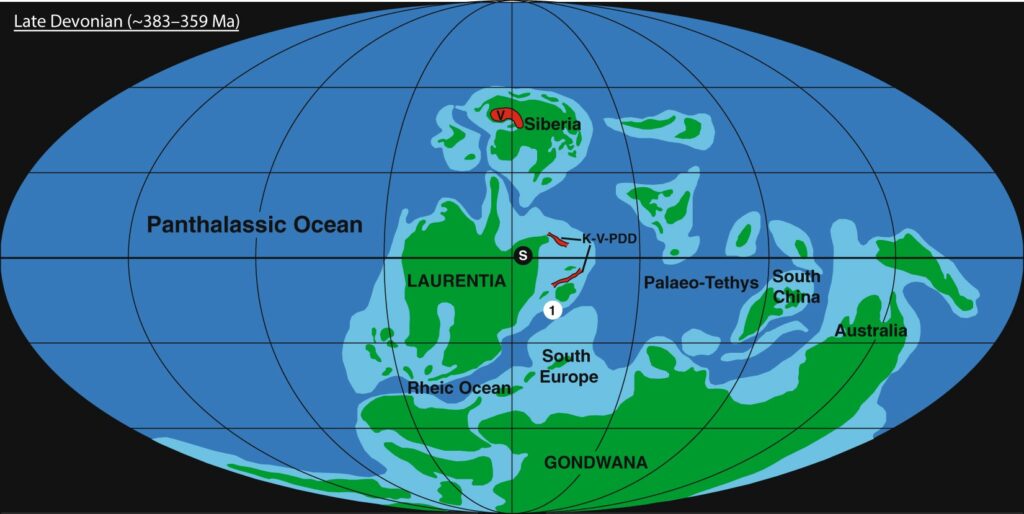
Over time, these fish diversified into numerous species. The fossil record suggests that coelacanths were once widespread and relatively successful. They occupied different marine environments and persisted through vast stretches of geological time.
Then the fossil evidence appeared to show something remarkable. Coelacanths seemed to disappear around the same time as many dinosaurs at the end of the Cretaceous Period.
Scientists naturally assumed that was the end of the story. Nature, however, had other plans.
The Discovery That Shocked the Scientific World
The modern story of the Coelacanth begins on December 22, 1938.
Along the coast of South Africa, a fishing trawler returned with its catch. Among the various fish hauled aboard was something unusual, something that immediately caught the attention of museum curator Marjorie Courtenay-Latimer.
She recognized that the fish looked unlike anything she had ever seen before. Its strange body, unusual fins, and distinctive features suggested it was something extraordinary. Unsure of exactly what she had found, she contacted ichthyologist J.L.B. Smith for assistance.
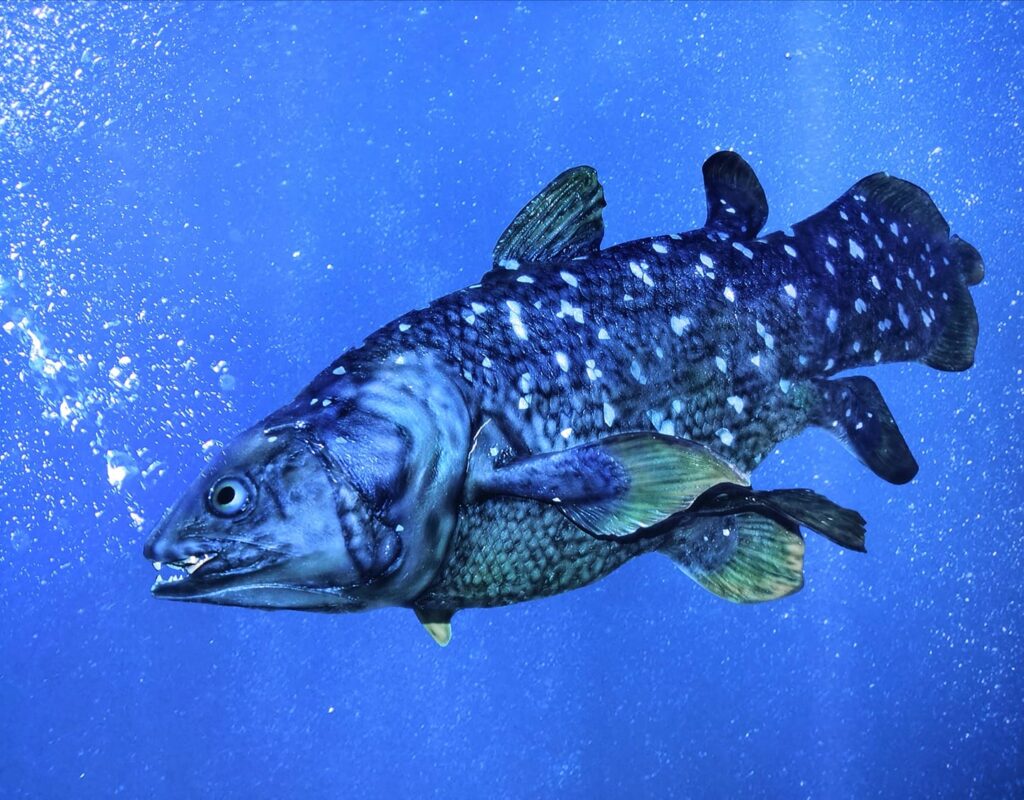
When Smith examined descriptions and sketches of the specimen, he could hardly believe it. The fish appeared to be a Coelacanth. A living Coelacanth. It was a fish believed extinct for tens of millions of years.
You can imagine the scientific equivalent of someone checking their glasses, cleaning them, checking again, and still refusing to accept what they were seeing.
Yet the evidence was undeniable.
The fish eventually became known as Latimeria chalumnae, named in honor of Marjorie Courtenay-Latimer and the Chalumna River area near where it was discovered.
Almost overnight, the Coelacanth transformed from a fossil known only from ancient rocks into a living species swimming in modern oceans.
Few discoveries have ever delivered such a dramatic shock to science.
Why the Coelacanth Looks So Strange
One glance at a Coelacanth and it becomes clear that this is no ordinary fish.
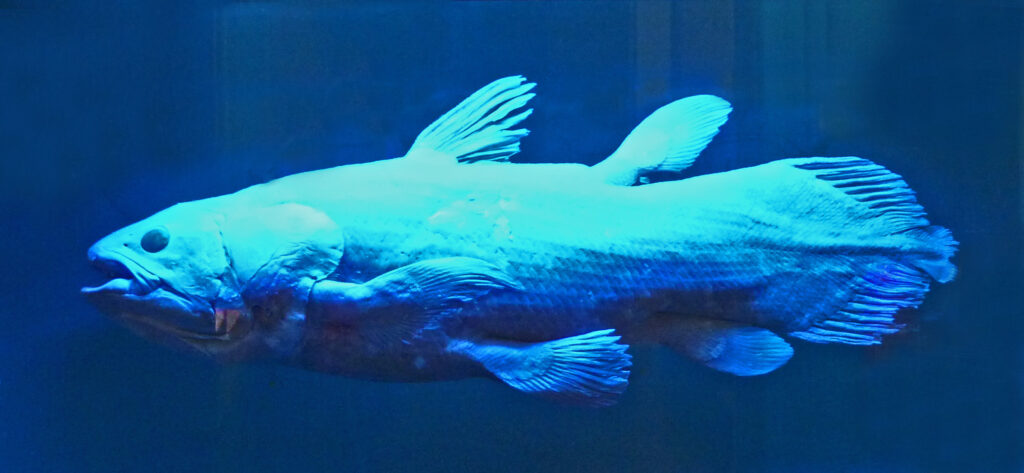
For starters, it can grow surprisingly large, reaching lengths of nearly six feet. Its body is covered with thick scales that act almost like armor. Its color ranges from deep blue to bluish-gray, helping it blend into the dim conditions of its underwater environment.
Then there are the fins. These are perhaps the most famous feature of the Coelacanth. Unlike the fins of many fish, the paired fins of a Coelacanth extend from fleshy, limb-like lobes. They move in a pattern that looks remarkably similar to the way four-legged animals walk.
Now, to be clear, the Coelacanth is not a fish that is secretly planning to stroll onto land and apply for a driver’s license. But these unusual fins offer important clues about the evolutionary history of vertebrates.
Scientists study them because they provide insight into the kinds of structures that eventually contributed to the evolution of limbs in land-dwelling animals.
Watching footage of a Coelacanth swimming can feel oddly familiar. Its coordinated fin movements seem less like traditional fish propulsion and more like a carefully choreographed underwater dance.
It is one of those moments where evolution suddenly feels less abstract and more visible.
Life in the Ocean’s Twilight Zone
If you’re hoping to spot a Coelacanth during a casual beach vacation, I have some disappointing news. You are not going to find one splashing around near the shoreline. The Coelacanth prefers a much quieter lifestyle.
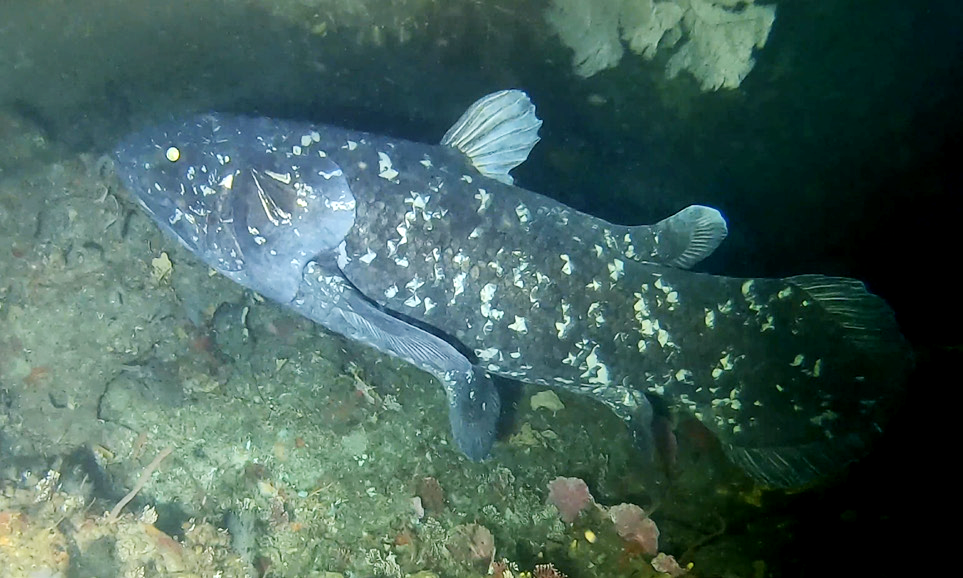
Most individuals inhabit deep waters, often several hundred feet below the surface and sometimes much deeper. They spend daylight hours sheltering within volcanic caves and rocky formations where darkness dominates the environment. It is an existence that feels almost tailor-made for avoiding human attention.
These fish generally emerge from their hiding places at night to hunt. In the darkness, they search for prey including smaller fish and cephalopods.
Living in such deep environments helps explain why the Coelacanth remained hidden for so long. Even after the famous 1938 discovery, finding additional specimens proved difficult. Scientists were not dealing with a species swimming through crowded harbors or shallow reefs.
They were searching for a ghost of prehistory in one of the most inaccessible habitats on Earth.
Frankly, if your survival strategy involves centuries of avoiding humans by hiding in underwater caves hundreds of feet down, you deserve a little respect.
How the Coelacanth’s Ancient Design Still Works
One of the most fascinating things about the Coelacanth is how little it seems to have changed compared to many other lineages.
This often leads people to call it a “living fossil.”
That phrase can be slightly misleading because evolution never truly stops. Modern Coelacanths are not identical to their ancient ancestors. They have continued evolving throughout their history. However, the overall body plan remains remarkably similar to fossil relatives from long ago.
In a world where countless species have undergone dramatic transformation, the Coelacanth appears almost stubbornly consistent.
Its existence raises an interesting question: If a design works exceptionally well, how much change is really necessary?
Evolution is not a process that constantly strives for novelty. It does not hand out awards for creativity. It favors traits that help organisms survive and reproduce within their environments.
For the Coelacanth, the deep ocean provided a stable habitat where major changes may not have been strongly advantageous. When your lifestyle is already successful, radical redesigns become less important.
The result is a fish that seems to bridge two distant worlds: the prehistoric past and the present day.
Weird Features You Won’t Find on Most Fish
The Coelacanth contains enough unusual anatomy to keep scientists busy for decades.
One especially intriguing feature is its intracranial joint. This unique structure allows part of the skull to move relative to another section. Few vertebrates possess anything quite like it. Researchers believe this adaptation may help the fish capture prey more effectively.
The Coelacanth also possesses a special organ in its snout that can detect electrical signals. This ability helps it locate prey in the darkness of deep water where visibility is limited. Think of it as a built-in biological sensing system.
Then there is the notochord. In many vertebrates, the notochord is largely replaced by a developed spinal column. The Coelacanth retains a large, fluid-filled notochord that serves as structural support.
Taken together, these features make the Coelacanth feel almost like an evolutionary museum exhibit that somehow escaped the display case and went back to living a normal life.
Every time scientists study the species, they gain additional insight into vertebrate evolution and the long history of life on Earth.
The Second Species of Coelacanth Nobody Expected
You might think that rediscovering a supposedly extinct fish would provide enough surprises for one century.
Apparently not.
For decades, scientists knew of only a single living species. Then, in 1997, researchers encountered another significant shock. A second living species of Coelacanth was identified in Indonesian waters. This species, later named Latimeria menadoensis, differed genetically and physically from the African species.
The discovery demonstrated that the Coelacanth story was even more complex than previously believed. Instead of representing a lone survivor confined to one region, the lineage persisted in multiple locations separated by vast distances.
Once again, the ocean reminded humanity that it does not reveal all of its secrets on demand.
Even in an age of satellites, advanced submersibles, and global communication, entire chapters of natural history can remain hidden beneath the waves.
What the Coelacanth Teaches Us About Evolution
The Coelacanth holds a special place in discussions about evolution because it helps illustrate what evolutionary science actually says.
A common misconception is that evolution always moves in a straight line toward greater complexity or dramatic transformation.
Reality is far messier.
Some species change rapidly. Others remain relatively stable for very long periods. Environmental pressures vary, opportunities differ, and successful adaptations can persist for astonishing lengths of time.
The Coelacanth demonstrates that survival is not about becoming the newest or flashiest organism on the block. It is about remaining effective within a particular ecological niche.
The fish also helps researchers explore the origins of major vertebrate groups. While the Coelacanth is not a direct ancestor of humans or modern land animals, it belongs to a branch of fish closely related to the lineages that eventually gave rise to terrestrial vertebrates.
As a result, studying the Coelacanth contributes valuable information about one of the most significant transitions in evolutionary history: the movement of vertebrates from water onto land.
Not bad for a fish whose favorite hobby appears to be hiding in caves and minding its own business.
Protecting a Rare Survivor
Despite surviving for hundreds of millions of years, the Coelacanth is not invincible.
Modern threats present challenges very different from those encountered throughout most of its evolutionary history.
Because Coelacanth populations appear relatively small, accidental capture in fishing operations can have significant impacts. Habitat disturbances and other human activities may also create problems for these ancient fish.
Conservation efforts now play an important role in protecting remaining populations.
Researchers continue monitoring known habitats, studying population dynamics, and gathering information that can guide management strategies.
There is something particularly compelling about conserving a species like the Coelacanth. Every species has value, of course. Yet preserving an animal with roots stretching deep into Earth’s distant past carries a unique emotional weight.
This is not merely another fish. This is a surviving representative of a lineage that witnessed chapters of planetary history almost beyond comprehension.
The Coelacanth survived asteroid impacts, mass extinctions, climate shifts, and continental rearrangements. It would be a tragic irony if the challenge it ultimately could not overcome turned out to be humanity’s fishing nets and environmental pressures.
The Enduring Mystery Beneath the Waves
Part of what makes the Coelacanth so captivating is that it remains mysterious.
Scientists have learned an incredible amount since 1938, but many questions persist.
How large are global populations? How exactly do different populations interact? What behaviors remain unobserved in their deep-water habitats? What additional evolutionary insights might future research uncover?
The deep ocean continues to limit our understanding.
Unlike animals that can be easily observed on savannas or in forests, the Coelacanth occupies an environment that is inherently difficult to study. Every expedition requires significant planning, specialized equipment, and a healthy dose of patience.
That challenge only adds to the creature’s appeal. The Coelacanth feels like a reminder that exploration is not over.
We sometimes talk as though the age of discovery ended centuries ago. Yet vast portions of our planet remain poorly understood, especially beneath the oceans. Somewhere in those dark waters, Coelacanths continue drifting through caves and rocky passages, living out their lives largely beyond human observation.
They are ambassadors from a world long vanished, carrying ancient stories in every scale and fin.
Why We Can’t Stop Being Fascinated by This Fish
The Coelacanth combines all the ingredients of a great story: It has mystery, scientific drama, a deep-time history, and a rediscovery so unbelievable that it sounds like fiction.
Most importantly, it reminds us that the natural world is often stranger and more wonderful than anything we could invent.
There is something deeply comforting about knowing that a creature presumed gone forever was quietly continuing its existence beneath the waves. While humans argued, theorized, and confidently declared its extinction, the Coelacanth simply kept doing what it had always done: Swimming. Hunting. Surviving.
The next time someone tells you that science has already discovered everything worth discovering, remember the Coelacanth. Remember that an animal thought lost for roughly 66 million years unexpectedly turned up in a fishing net. Remember that entire worlds still exist beyond our everyday experience.
And remember that somewhere in the depths of the ocean, a blue-gray fish with ancient origins is gliding through the darkness, completely unaware that it has become one of the greatest comeback stories in the history of science.
For a creature that supposedly vanished before humanity ever appeared, the Coelacanth has done a remarkable job of having the last laugh.
Help Keep the Quest Alive
If my essays, ocean-life explorations, theatrical deep dives, or stories have brought a little wonder into your world, I’d love your help creating more.
Every Spark of Magic helps support the time, research, and creativity behind Phantom Orca Quest—from new essays and book projects to the next deep dive into the worlds I love.
You don’t have to give to enjoy my work. But if you’d like to help keep these creative quests going, your support truly means a lot.
✨ Send a Spark of Magic on Ko-fi
Thank you for being part of the Quest.
